Corporate Governance & Business Integrity
Operating with transparency, accountability, auditability, and ethics
Corporate Governance and Business IntegrityMateriality Level : High

Targets and Performance
| Indicator | Long-term Target 2030 |
Target 2025 |
Performance 2025 |
|---|---|---|---|
| Board Diversity | At least 2 female directors |
At least 1 female director |
No female directors |
| Board and Sub-Committee Meeting Attendance Rate | 100% | 100% | 100% |
| Corporate Governance Rating (CGR) | 5-star or Excellent |
5-star or Excellent |
3-star or Good |
| Employees Passing Ethics & Code of Conduct Assessment | 100% | 100% | 100% |
| Suppliers Receiving Ethics Communication | 100% | 100% | 100% |
| Significant Legal/Regulatory Violations (cases) | 0 cases | 0 cases | 0 cases |
| Ethics/Corruption Complaints (cases) | 0 cases | 0 cases | 1 case |
Risks and Opportunities from Corporate Governance
Governance lacking effective mechanisms and processes may lead to non-compliance with environmental laws and standards, causing pollution, improper waste management, and inefficient resource use — impacting ecosystems, community health, corporate reputation, and increasing restoration costs. Unethical business conduct, or violations of human rights, labor laws, and safety standards may lead to disputes, distrust, and pressure from regulators and investors, as well as compliance risk resulting in fines, license revocation, or operational disruptions — affecting revenue, confidence, and long-term organizational stability. Corruption distorts decision-making, reduces efficiency, and undermines competitiveness, limiting opportunities to participate in ESG-focused projects or supply chains.
The Company therefore emphasizes transparent and ethical corporate governance with prevention of all forms of corruption, which reduces operational risks, strengthens environmental governance and legal compliance, improves resource efficiency, and supports eco-friendly industrial estate development. Respecting labor rights and systematic stakeholder engagement builds trust and positive relationships with all sectors. Verifiable transparency also increases access to sustainable financing, such as Sustainability-linked Loans and ESG-focused funds, reducing financial costs, enhancing corporate image, and supporting long-term growth.
Strategy and Management
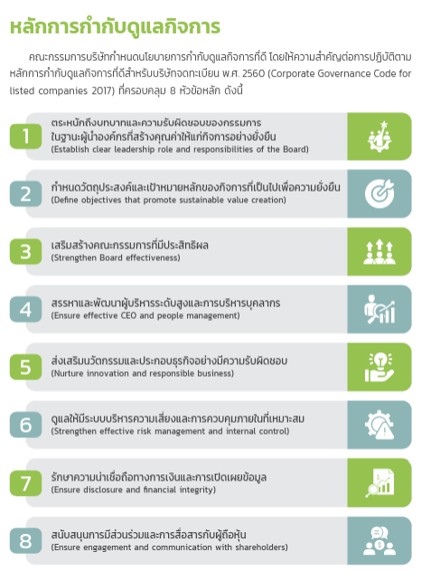
The Company is committed to good corporate governance, adhering to the principles of transparency, accountability, fairness, and auditability as a framework for organizational management — building confidence among shareholders, investors, and all stakeholders, and supporting long-term stable growth of the industrial estate. Operations are conducted under the framework of the Public Company Limited Act, laws and regulations of the Securities and Exchange Commission, regulations of the Stock Exchange of Thailand, and the Corporate Governance Code for listed companies — an important foundation for building credibility and organizational stability. To ensure systematic corporate governance, the Company has established the “Good Corporate Governance Policy” as a framework for defining policies, strategies, and business direction, adhering to 8 principles covering board roles and responsibilities, setting organizational objectives, strengthening board effectiveness, nomination and development of executives and personnel, responsible business conduct, risk management and internal control, financial integrity and disclosure, as well as promoting shareholder rights and participation.
The Board of Directors sets policies, strategies, and oversees the organization in line with good governance principles, while monitoring performance and ensuring appropriate risk management and internal control systems. The Nomination and Compensation Committee considers nominations, appointments, and compensation for directors and senior executives in accordance with their roles, responsibilities, and performance, as set out in the “Director and Senior Executive Nomination and Remuneration Policy”, with transparent disclosure in the Annual Report 56-1 One Report. In addition, the Company has established the “Anti-Corruption Policy” and regulations on giving and receiving gifts and hospitality for directors, executives, and employees to foster a culture of integrity, and has put in place the “Whistle Blowing Policy” with appropriate whistleblower protection measures. In 2025, the Company declared its intention to join the Thai Private Sector Collective Action Against Corruption (CAC) to affirm its commitment to transparent and ethical business conduct.


Corporate Governance Principles
Board of Directors Structure
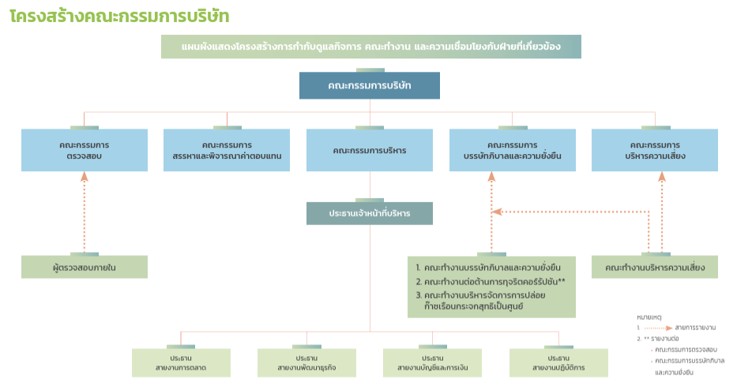
The Company has defined a corporate governance structure with clearly separated roles and responsibilities between the Chairman and the Chief Executive Officer to ensure effective and transparent governance and management. The Chairman sets policies, oversees, and provides strategic recommendations to management to ensure operations align with organizational objectives and good governance principles, while the CEO is responsible for business management and driving strategy into daily operational implementation. This separation of roles helps strengthen appropriate checks and balances and elevates transparency in corporate governance.
Additionally, the Board of Directors oversees sustainability development issues in an overall capacity and has assigned the Corporate Governance and Sustainability Committee to monitor sustainability development performance on a quarterly basis and report results to the Board of Directors for consideration and guidance on operational direction.
Changes in Corporate Governance Structure
On November 14, 2025, the Board of Directors Meeting No. 4/2025 resolved to restructure the corporate governance structure by appointing two additional sub-committees: the Corporate Governance and Sustainability Committee and the Risk Management Committee, to strengthen governance mechanisms covering both governance and risk management aspects, and to support efficient, transparent, fair, and auditable business management systems that will help drive the organization toward achieving its vision and mission, while building confidence among all levels of personnel and both direct and indirect stakeholders.
Board Composition
As of December 31, 2025, the Company has a total of 9 Board members, comprising 4 independent directors (44.4%), 1 non-executive director, and 4 executive directors.
In terms of gender diversity, the Board consists of 9 male directors with no female directors on the Board (0%).
| ที่ | Board of Directors | Executive Director | Non-Executive Director | Independent Director | Other Listed Company Positions | |
|---|---|---|---|---|---|---|
| Name | Position | |||||
| 1 | นายประสาน ตันประเสริฐ |
– กรรมการ
– ประธานกรรมการบริษัท
|
✓ | ✓ | ไม่มี | |
| 2 | พล.ต.อ.อุดม รักศิลธรรม |
– กรรมการ
– ประธานกรรมการตรวจสอบ
– กรรมการบรรษัทภิบาลและความยั่งยืน*
|
✓ | ✓ | ไม่มี | |
| 3 | ดร.สุรินทร์ ตันติเจริญเกียรติ |
– กรรมการ
– ประธานกรรมการสรรหาและพิจารณาค่าตอบแทน
– กรรมการบริหารความเสี่ยง*
|
✓ | ✓ | ไม่มี | |
| 4 | นายประเสริฐ ภัทรดิลก |
– กรรมการ
– ประธานกรรมการบรรษัทภิบาลและความยั่งยืน*
– กรรมการสรรหาและพิจารณาค่าตอบแทน
– กรรมการบริหารความเสี่ยง*
|
✓ | ✓ | มี (4 แห่ง) | |
| 5 | นายพีระ บัทมวรกุลชัย |
– กรรมการ
– ประธานกรรมการบริหาร
– ประธานเจ้าหน้าที่บริหาร
|
✓ | ไม่มี | ||
| 6 | นายพีร์ บัทมวรกุลชัย |
– กรรมการ
– กรรมการสรรหาและพิจารณาค่าตอบแทน
– กรรมการบรรษัทภิบาลและความยั่งยืน*
– กรรมการบริหาร
– รองประธานเจ้าหน้าที่บริหาร
|
✓ | ไม่มี | ||
| 7 | นายสุจินต์ เรียบวิริยะกิจ |
– กรรมการ
– ประธานกรรมการบริหารความเสี่ยง*
– กรรมการบริหาร
|
✓ | ไม่มี | ||
| 8 | นายสุเรนทร์ สุวรรณวงศ์กิจ |
– กรรมการ
– กรรมการบริหาร
|
✓ | ไม่มี | ||
| 9 | นายรัฐวัฒน์ ศุขสายชล |
– กรรมการ
|
✓ | มี (1 แห่ง) | ||
| Total | 4 | 5 | 4 | |||
| Note: (*) Appointed by the Board of Directors on November 14, 2025 | ||||||
Director and Executive Nomination
All Board members go through a systematic nomination process, considering qualifications as required by law and the Securities and Exchange Commission (SEC) regulations, along with assessment of appropriate knowledge, expertise, and experience relevant to the industrial estate business context. The Nomination and Remuneration Committee establishes criteria and nomination processes to ensure the Board can perform oversight duties effectively and create value for the Company and all stakeholder groups.
The Company has a systematic, transparent director nomination and appointment process aligned with good corporate governance principles. The Nomination and Remuneration Committee evaluates the suitability of nominees based on qualifications, knowledge, capabilities, experience, specific expertise, independence, and diversity of skills, age, gender, and experience beneficial to determining the Company's business direction. The Committee verifies that nominees possess complete qualifications and no prohibited characteristics under relevant laws and regulations before submitting the list to the Board of Directors for consideration and proposing to the shareholders' meeting for approval under established procedures, ensuring the Company obtains directors with appropriate qualifications capable of performing duties effectively and supporting the Company's growth.
To ensure comprehensive governance, the Company has developed a Board Skill Matrix to identify and assess the necessary skills, expertise, and experience of directors in various dimensions, such as industrial estate business management, finance and accounting, law, risk management, corporate governance, and sustainability development issues, which helps the Company systematically evaluate the appropriateness of board composition and use as information for future director recruitment and development planning.
Board Skill Matrix
| ที่ | Director Name | Position |
บัญชี / การเงิน
|
เศรษฐศาสตร์
|
อสังหาริมทรัพย์
|
พลังงาน
|
สาธารณูปโภค
|
กลยุทธ์
|
การประกอบธุรกิจ
|
การบริหารธุรกิจ
|
วิศวกรรมศาสตร์
|
กฎหมาย
|
วาณิชและการระดมทุน
|
การบริหารความเสี่ยง
|
การตรวจสอบ/ตรวจสอบภายใน
|
บรรษัทภิบาล/กำกับดูแล
|
|---|---|---|---|---|---|---|---|---|---|---|---|---|---|---|---|---|
| 1 | นายประสาน ตันประเสริฐ |
– กรรมการ
– ประธานกรรมการบริษัท
|
✓ | ✓ | ✓ | ✓ | ✓ | ✓ | ✓ | ✓ | ✓ | ✓ | ✓ | |||
| 2 | พล.ต.อ.อุดม รักศิลธรรม |
– กรรมการ
– ประธานกรรมการตรวจสอบ
– กรรมการบรรษัทภิบาลและความยั่งยืน*
|
✓ | ✓ | ✓ | ✓ | ✓ | ✓ | ✓ | |||||||
| 3 | ดร.สุรินทร์ ตันติเจริญเกียรติ |
– กรรมการ
– ประธานกรรมการสรรหาและพิจารณาค่าตอบแทน
– กรรมการบรรษัทภิบาลและความยั่งยืน*
– กรรมการบริหารความเสี่ยง*
|
✓ | ✓ | ✓ | ✓ | ✓ | ✓ | ✓ | ✓ | ✓ | ✓ | ✓ | |||
| 4 | นายประเสริฐ ภัทรดิลก |
– กรรมการ
– ประธานกรรมการบรรษัทภิบาลและความยั่งยืน*
– กรรมการสรรหาและพิจารณาค่าตอบแทน
– กรรมการบริหารความเสี่ยง*
|
✓ | ✓ | ✓ | ✓ | ✓ | ✓ | ✓ | ✓ | ✓ | ✓ | ✓ | |||
| 5 | นายพีระ บัทมวรกุลชัย |
– กรรมการ
– ประธานกรรมการบริหาร
– ประธานเจ้าหน้าที่บริหาร
|
✓ | ✓ | ✓ | ✓ | ✓ | ✓ | ✓ | ✓ | ✓ | ✓ | ||||
| 6 | นายสุจินต์ เรียบวิริยะกิจ |
– กรรมการ
– ประธานกรรมการบริหารความเสี่ยง*
– กรรมการบริหาร
|
✓ | ✓ | ✓ | ✓ | ✓ | ✓ | ✓ | ✓ | ✓ | ✓ | ✓ | |||
| 7 | นายพีร์ บัทมวรกุลชัย |
– กรรมการ
– กรรมการสรรหาและพิจารณาค่าตอบแทน
– กรรมการบรรษัทภิบาลและความยั่งยืน*
– กรรมการบริหาร
– รองประธานเจ้าหน้าที่บริหาร
|
✓ | ✓ | ✓ | ✓ | ✓ | ✓ | ✓ | ✓ | ✓ | ✓ | ||||
| 8 | นายสุเรนทร์ สุวรรณวงศ์กิจ |
– กรรมการ
– กรรมการบริหาร
|
✓ | ✓ | ✓ | ✓ | ✓ | |||||||||
| 9 | นายรัฐวัฒน์ ศุขสายชล |
– กรรมการ
|
✓ | ✓ | ✓ | ✓ | ✓ | ✓ | ✓ | |||||||
| Total | 7 | 7 | 5 | 2 | 3 | 9 | 8 | 8 | 4 | 2 | 5 | 9 | 5 | 9 | ||
| Note: (*) Appointed by the Board of Directors on November 14, 2025 | ||||||||||||||||
Board Knowledge Development
The Company places importance on continuously developing the capabilities of board members to enable effective governance, in compliance with relevant laws, regulations, and best practices for listed companies, by promoting and supporting directors to regularly participate in training and seminars related to business operations, corporate governance, and legal and organizational development issues.
In 2025, 4 directors, namely Pol.Gen. Udom Raksilathum, Mr. Prasert Pattaradilok, and Dr. Surin Tantijernkiart of the Audit Committee, attended training to develop knowledge on audit committee roles and responsibilities and strengthen governance standards in line with listed company practices. Mr. Pheera Pattamavorakunchai, Chief Executive Officer, also attended training to develop knowledge and capabilities, with details as follows:
| Director | Course | Organizer |
|---|---|---|
| พล.ต.อ.อุดม รักศิลธรรม | Transforming One Report with IFRS S Integration | EY Thailand |
| Hot Issue for Directors: The Evolving Role of Audit Committee in Fostering Trust and Transparency | ตลาดหลักทรัพย์ฯ และ สมาคมส่งเสริมสถาบันกรรมการบริษัทไทย | |
| THE EVOLVING ROLE OF AUDIT COMMITTEE IN FOSTERING TRUST AND TRANSPARENCY การพัฒนาบทบาทของคณะกรรมการตรวจสอบ เพื่อความโปร่งใสและความไว้วางใจแก่ผู้เกี่ยวข้อง (ครั้งที่ 1/2568) | ตลาดหลักทรัพย์แห่งประเทศไทย | |
| นายประเสริฐ ภัทรดิลก | เจาะลึกความคาดหวังต่อบทบาทและการปฏิบัติหน้าที่อย่างเหมาะสมของคณะกรรมการตรวจสอบและหัวหน้าหน่วยงานตรวจสอบภายใน (CAE) | ตลาดหลักทรัพย์แห่งประเทศไทย และ สภาวิชาชีพในพระบรมราชูปถัมภ์ |
| The Strategic Role of an Audit Committee in Cybersecurity Oversight | PwC | |
| Transforming One Report with IFRS S Integration | EY Thailand | |
| Audit Committee Forum No.56: Audit Committee Priorities 2025 "Enhance Audit Committee Effectiveness" | KPMG Thailand | |
| Greenwashing: Can You Green Claim Stand Up to Scrutiny? | EY Thailand | |
| Embedding Trust in an AI-Driven World: Cybersecurity Insights 2025 | Insights 2025 KPMG Thailand | |
| Hot Issue for Directors: The Evolving Role of Audit Committee in Fostering Trust and Transparency | ตลาดหลักทรัพย์ฯ และ สมาคมส่งเสริมสถาบันกรรมการบริษัทไทย | |
| Audit Committee: How to Capture Value from M&A | PwC | |
| 2025 Audit Committee Seminar: In the Winds of Change | EY Thailand | |
| ดร.สุรินทร์ ตันติเจริญเกียรติ | Transforming One Report with IFRS S Integration | EY Thailand |
| Hot Issue for Directors: The Evolving Role of Audit Committee in Fostering Trust and Transparency | ตลาดหลักทรัพย์ฯ และ สมาคมส่งเสริมสถาบันกรรมการบริษัทไทย | |
| THE EVOLVING ROLE OF AUDIT COMMITTEE IN FOSTERING TRUST AND TRANSPARENCY การพัฒนาบทบาทของคณะกรรมการตรวจสอบ เพื่อความโปร่งใสและความไว้วางใจแก่ผู้เกี่ยวข้อง (ครั้งที่ 1/2568) | ตลาดหลักทรัพย์แห่งประเทศไทย | |
| นายพีระ ปัทมวรกุลชัย | Market Outlook H1/2025, Outlook H2/2025 | SCB Julius Baer |
| สัมมนาเศรษฐกิจปีนี้ | บล.บียอนด์ | |
| Mid Year Economics – Investment Outlook | Krungsri Private Banking | |
| Future Ready Beyond 2025 | บล.บียอนด์ | |
| The Legacy Blueprint | SCB WEALTH & Baker & McKenzie | |
| Rise Above Global – Decoupling | บล.บียอนด์ |
Performance Evaluation and Monitoring
The Company requires performance evaluation of the Board of Directors, sub-committees, and the Chief Executive Officer at least once a year to review performance and enhance governance efficiency for maximum benefit to the Company.
The evaluation uses assessment forms based on the Stock Exchange of Thailand guidelines, adapted to the Company's context and structure, along with consideration of meeting attendance criteria and self-assessments of directors at both individual and committee levels. The Company has clearly defined evaluation criteria and analyzes the results to develop guidelines or governance improvement plans for the Board.
The evaluation of the Board and sub-committees, both at the committee and individual levels, calculates scores as a percentage of the full score based on defined criteria, and determines performance levels to reflect the effectiveness of duties. Results are analyzed both comprehensively and by issue to identify strengths and areas for improvement, with development guidelines set in accordance with the roles, duties, and responsibilities of the Board, promoting an efficient and transparent governance system capable of supporting organizational growth.
| Board of Directors Performance Evaluation 2025 | ||
|---|---|---|
| Evaluation Topic | Group Evaluation | Individual Evaluation |
| Board Structure and Qualifications | ✓ | ✓ |
| Board Roles, Duties and Responsibilities | ✓ | ✓ |
| Board Meetings | ✓ | ✓ |
| Board Performance | ✓ | |
| Relationship with Management | ✓ | |
| Director Self-Development and Executive Development | ✓ | |
| Committee | Meetings | Performance Evaluation Score | ||
|---|---|---|---|---|
| Count (times) | Attendance Rate (%) | Group (%) | Individual (%) | |
| Board of Directors | 5 | 100 | 98 | 99 |
| Audit Committee | 7 | 100 | 100 | 98 |
| Nomination & Remuneration Committee | 2 | 100 | 99 | 99 |
| Executive Committee | 28 | 100 | 91 | 85 |
| CEO | 99 | |||
| Risk Management Committee (formerly Audit Committee) |
4 | 100 | - | - |
| Corporate Governance & Sustainability Committee (formerly Audit Committee) |
2 | 100 | - | - |
| Note : The Risk Management Committee and Corporate Governance and Sustainability Committee were appointed on November 14, 2025. Therefore, in 2025 there were no meetings or performance evaluations held. However, the Risk Management Working Group held 4 meetings and the Sustainability Working Group held 2 meetings in 2025, reporting to the Audit Committee. | ||||
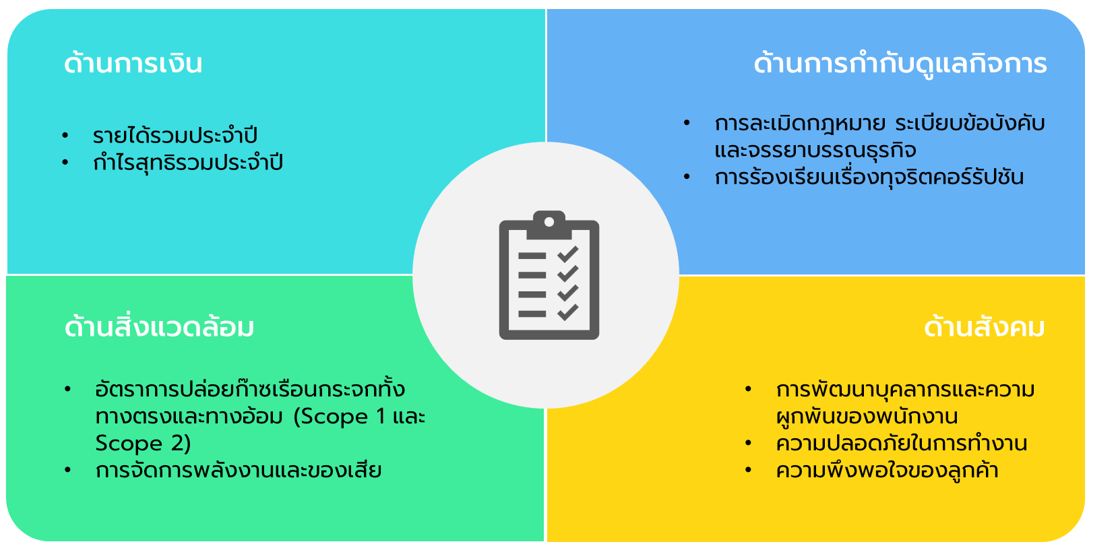
Additionally, the Company requires annual performance evaluations of the Chief Executive Officer (CEO), linked to the Company's strategic and annual plans to ensure management alignment with business growth goals alongside sustainable development. Sustainability performance results are incorporated as Key Performance Indicators (KPIs), and the evaluation results are used as part of determining remuneration for the CEO, directors, and senior executives, with environmental, social, and governance indicators weighted alongside financial performance in a concrete manner. This approach reflects the connection between performance outcomes, stakeholder accountability, and long-term value creation, while encouraging executives at all levels to drive the organization under good corporate governance principles and sustainable development. The performance evaluation topics are as follows:
Sustainability Development Governance
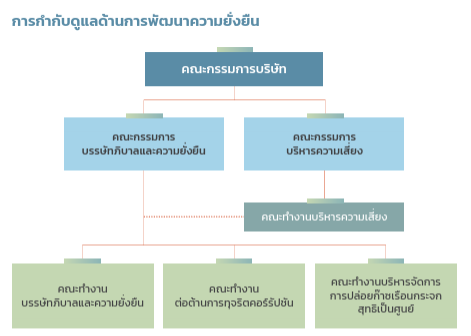
The Corporate Governance and Sustainability Committee was appointed pursuant to the Board of Directors Meeting No. 4/2025 resolution on November 14, 2025. It plays a role in governing, overseeing, and driving operations in good corporate governance and organizational sustainability, including reviewing and revising policies, practices, and business ethics to comply with relevant laws, regulations, and standards; oversight of compliance; anti-corruption prevention; promotion of governance culture within the organization; as well as setting and monitoring ESG sustainability strategies including climate change issues and related risks, in order to elevate corporate governance standards and create long-term value for the business and all stakeholders.
The Committee is required to meet at least once per year, report performance results to the Board of Directors annually, and conduct performance evaluations at least once per year. However, since the appointment took effect at the end of 2025, the Corporate Governance and Sustainability Committee had not yet held a meeting during that year. Nevertheless, the Sustainability Working Group held 2 meetings to continuously report progress and performance results to the Audit Committee meeting.
Board Oversight and Monitoring
In 2025, the Company held a total of 6 Board of Directors and Audit Committee meetings, with agendas covering monitoring, performance reporting, performance verification, as well as the development and enhancement of corporate governance, risk management, internal audit, and driving organizational sustainability development. In 2026, the Company has held 2 meetings of the relevant committees to date, continuously monitoring and considering key issues. The 2026 meeting schedule is still in progress, and additional meetings may be held in accordance with the plan and designated agendas (2026 meeting information is as of 1 March 2026).
The relevant meeting agenda details are shown in the summary table below.
| Meeting No. | Audit Committee | Meeting No. | Board of Directors |
|---|---|---|---|
| Meeting Agenda | Meeting Agenda | ||
|
Meeting 1/2025 19 Feb 2025 |
• Considered and approved the review of the following Charters: – Risk Management Working Group Charter – Internal Audit Department Charter • Acknowledged the Internal Audit Report of the Internal Audit Department for the first quarter of 2025. • Acknowledged the Follow-up Report on the Internal Control System Audit by the Internal Audit Department. • Acknowledged the Report on the Assessment of the Adequacy of the Internal Control System (COSO). • Considered and approved the Risk Management Plan for 2025. • Acknowledged the 6-month Risk Management Performance Summary Report as of December 31, 2024. |
Meeting 1/2025 19 Feb 2025 |
• Considered and approved the Risk Management Plan for 2025. • Considered the review of the charters and scopes as follows: – Risk Management Working Group Charter – Sustainability Working Group (ESG) Charter – Internal Audit Department Charter • Considered the review of the vision, mission and strategy for 2025. • Considered the performance evaluation results of the Board of Directors and Sub-Committees for 2024. • Acknowledged the Internal Audit Report of the Internal Audit Department for the first quarter of 2025. • Acknowledged the Follow-up Report on the Internal Control System Audit by the Internal Audit Department. • Acknowledged the Report on the Assessment of the Adequacy of the Internal Control System (COSO). • Acknowledged the 6-month Risk Management Performance Summary Report as of December 31, 2024. |
|
Meeting 2/2025 9 May 2025 |
• Acknowledged the report on the Company’s ESG operations. |
Meeting 2/2025 15 May 2025 |
• Acknowledged the Internal Audit Report of the Internal Audit Department for the second quarter of 2025. |
|
Meeting 3/2025 15 May 2025 |
• Acknowledged the Internal Audit Report of the Internal Audit Department for the second quarter of 2025. |
Meeting 3/2025 13 Aug 2025 |
• Considered and approved the following policies: – Tax Policy – Director and Top Executives Nomination and Remuneration Policy – Self-evaluation policy and guidelines for the Board of Directors, Subcommittees and Chief Executive Officer Policy • Considered and approved amendments to the following policies: – Human Rights and Labor Practices Policy – Directors, Executives and Employees Development Policy and Guidelines – Succession Planning Policy for Key Executive Positions • Acknowledged the Internal Audit Report of the Internal Audit Department for the third quarter of 2025. • Acknowledged the 6-month Risk Management Performance Report (January–June 2025). |
|
Meeting 4/2025 13 Aug 2025 |
• Acknowledged the Internal Audit Report of the Internal Audit Department for the third quarter of 2025. • Acknowledged the 6-month Risk Management Performance Report (January–June 2025). |
Meeting 4/2025 14 Nov 2025 |
• Considered and approved changes to the Company’s corporate governance structure. • Considered the appointment of the Corporate Governance and Sustainability Committee and its Chairman. • Considered the appointment of the Risk Management Committee and its Chairman. • Considered and approved the charters and scopes of authority of the Sub-Committees: – Corporate Governance and Sustainability Committee Charter – Risk Management Committee Charter • Considered and approved the Company’s policies as follows: – Information Classification Policy and Guidelines – Anti-Unfair Competition Policy – Biodiversity and Business Sustainability Policy – Green Construction Policy – Board Diversity Policy – Sustainable Supply Chain Management Policy – Environmental and Climate Change Policy – Responsible Stakeholder Communication and Engagement Policy – Business Continuity Management Policy • Considered and approved amendments to the Company’s policies: – Whistle Blowing Policy – Corporate Social Responsibility Policy • Considered and approved amendments to the scope of authority of the Chief Executive Officer (ESG). • Considered and approved joining the Thai Private Sector Collective Action Against Corruption (CAC). • Considered and approved the appointment of the internal auditor and the determination of the remuneration for 2026. • Considered and approved the Internal Audit Plan for 2026. • Acknowledged the list of potential assets under the Framework Agreement for Business Operations. • Acknowledged the Internal Audit Report of the Internal Audit Department for the fourth quarter of 2025. • Acknowledged the Follow-up Report on the Internal Control System Audit by the Internal Audit Department. • Acknowledged the Whistleblowing Report for 2025. |
|
Meeting 5/2025 29 Oct 2025 |
• Acknowledged the ESG Sustainability Performance Report for 2025. |
Meeting 5/2025 27 Nov 2025 |
• Considered and approved a connected transaction relating to real estate leasing. |
|
Meeting 6/2025 14 Nov 2025 |
• Acknowledged the list of potential assets under the Framework Agreement for Business Operations. • Acknowledged the Internal Audit Report of the Internal Audit Department for the fourth quarter of 2025. • Acknowledged the Follow-up Report on the Internal Control System Audit by the Internal Audit Department. • Considered and approved the appointment of the internal auditor and the determination of the remuneration for 2026. • Considered and approved the Internal Audit Plan for 2026. • Acknowledged the Whistleblowing Report for 2025. |
||
|
Meeting 1/2026 20 Jan 2026 |
• There were no meeting agenda related to monitoring and reporting on sustainability performance. |
Meeting 1/2026 20 Jan 2026 |
• There were no meeting agenda related to monitoring and reporting on sustainability performance. |
|
Meeting 2/2026 24 Feb 2026 |
• Considered and approved the review and revision of the following Charters: – Audit Committee Charter – Internal Audit Department Charter • Acknowledged the Audit Committee’s Annual Performance Report for 2025. • Acknowledged the Internal Audit Report of the Internal Audit Department for the first quarter of 2025. • Acknowledged the Follow-up Report on the Internal Control System Audit by the Internal Audit Department. • Acknowledged the Report on the Assessment of the Adequacy of the Internal Control System (COSO). • Acknowledged the results of fraud and corruption cases for 2025. |
Meeting 2/2026 24 Feb 2026 |
• Considered and approved the Risk Management Plan and Risk Management Manual for 2026. • Considered and approved the ESG Action Plan for 2026. • Considered and approved the review and revision of the relevant charters and scopes. • Considered and approved the Safety, Occupational Health and Working Environment Policy. • Considered and approved the revisions to the Company’s policies as follows: – Good Corporate Governance Policy (1st Revision) – Code of Conduct (2nd Revision) – Anti-Corruption Policy (3rd Revision) – Risk Management Policy (1st Revision) – Self-evaluation policy and guidelines for the Board of Directors, Subcommittees and Chief Executive Officer Policy (1st Revision) • Considered and approved the performance evaluation results of the Board of Directors and Sub-Committees for 2025. • Acknowledged the Audit Committee’s Annual Performance Report for 2025. • Acknowledged the Nomination and Remuneration Committee’s Annual Performance Report for 2025. • Acknowledged the Internal Audit Report of the Internal Audit Department for the first quarter of 2025. • Acknowledged the Follow-up Report on the Internal Control System Audit by the Internal Audit Department. • Acknowledged the Report on the Assessment of the Adequacy of the Internal Control System (COSO). • Acknowledged the 6 months Risk Management Performance Report as of December 31, 2025. • Acknowledged the Sustainability Performance Report for 2025. • Acknowledged the results of the Company’s declaration of intent and participation in the Thai Private Sector Collective Action Against Corruption (CAC). • Acknowledged the results of fraud and corruption cases for 2025. |
Conflict of Interest Prevention
The Company has established a conflict of interest prevention policy to prevent and avoid any actions that may create conflicts between personal interests and the Company's interests, whether in dealings with suppliers, customers, business competitors, or using opportunities and information obtained from duties for personal benefit. Employees with interests are required to abstain from participating in consideration, approval, agreement to enter into transactions, or any actions on behalf of the Company in matters that may create conflicts of interest. At the board and executive level, the Company requires that consideration of related transactions between the Company and persons or juristic persons who may be involved must be conducted carefully, transparently, and independently, under a sound ethical framework, with the utmost benefit to the Company and shareholders as the primary consideration.
Corporate Governance Assessment Results
The Company received a 3-star or “Good” rating in the Corporate Governance Report of Thai Listed Companies (CGR) for 2025 from the Thai Institute of Directors Association (IOD), supported by the Securities and Exchange Commission (SEC) and the Stock Exchange of Thailand. The Company remains committed to further developing and elevating corporate governance standards toward the Excellent CG Scoring level.
Business Ethics and Anti-Corruption
The Company conducts business under the principles of integrity, fairness, accountability, and business ethics, with good corporate governance as an important foundation for management and operations at every step, from project planning and development, coordination with government and private agencies, to providing services to operators and investors, to ensure operations are transparent, auditable, and free from all forms of corruption.
To achieve this intention, the Company has established an Anti-Corruption Policy as mandatory guidelines for directors, executives, and employees at all levels, clearly stating that it will not demand, give, accept, or tolerate any form of corruption, with defined roles, responsibilities, and monitoring mechanisms, including regular policy reviews to align with changes in the business environment, laws, and relevant regulations. In addition, the Company has established a Code of Conduct for directors, executives, and employees as a framework for correct and appropriate conduct, as well as a Supplier Code of Conduct to encourage suppliers to conduct business ethically, transparently, and in accordance with the law.
The Company communicates these policies and practices both internally through orientation, training, notice boards, and electronic systems so that all employees study, understand, and strictly adhere to them, as well as externally through the company website, annual report, and sustainability report to inform stakeholders of the Company's approach and support the building of a corporate culture committed to good governance.



| Responsible Unit | Roles and Responsibilities |
|---|---|
| Board of Directors | Establishes anti-corruption policies against all direct and indirect forms of corruption, and oversees systems, mechanisms, and resources that effectively support fraud prevention throughout the organization. |
| Audit Committee | Reviews company operations and ensures adequate internal control systems for corruption risk prevention, regularly reporting performance to the Board of Directors. |
| Corporate Governance & Sustainability Committee | Oversees and establishes an operational framework for appropriate anti-corruption measures in the business context, promotes awareness and compliance at all levels, appoints relevant working groups, and reports to the Board. |
| Risk Management Committee | Regularly assesses and monitors corruption risks in key organizational processes, establishes risk management approaches, and reports to the Board of Directors. |
| Internal Auditor (A.M.T. Solution Co., Ltd.) | Audits and reviews operations for compliance with relevant policies, laws, and regulations to ensure adequate internal controls, including fraud and corruption investigations beyond the planned audit scope, reporting to the Audit Committee. |
| Chief Executive Officer (CEO) | Communicates, promotes, and monitors anti-corruption policy compliance throughout the organization, cooperates in complaint investigations, and appoints working groups to consider and investigate related cases when necessary. |
| Anti-Corruption Working Group | Responsible for implementing assigned anti-corruption measures, including participation in the CAC program and reporting performance to the Corporate Governance and Sustainability Committee. |
| Employees | Perform duties with integrity, do not solicit or give bribes, comply with the Company's anti-corruption policy and practices, report whistleblowing or any acts that may constitute corruption, and cooperate in investigations transparently. |
In 2025, the Company held anti-corruption meetings (corruption risk assessments) by the Risk Management Working Group 4 times per year to report performance to the Audit Committee. In addition, at the Board of Directors Meeting No. 4/2025 on November 14, 2025, the Company Secretary reported a summary of whistleblowing reports for 2025 for the Audit Committee and Board of Directors to acknowledge.
Ethics, Code of Conduct, and Anti-Corruption Communication and Cultivation
The Company places importance on cultivating knowledge, understanding, and anti-corruption awareness throughout the supply chain by providing training on the Anti-Corruption Policy and Code of Conduct from the new employee orientation process to build correct understanding of good governance, business ethics, and desired work practices, as well as providing training and knowledge reviews for employees at all levels. This is coupled with promoting a corporate culture committed to transparency, integrity, and corruption-free business operations. The Company also communicates relevant policies and practices to directors, executives, employees at all levels, and suppliers through various channels such as notice boards and electronic systems (Email) for all relevant parties to acknowledge, understand, and strictly adhere to.
The Company conducted Code of Conduct training to review and strengthen knowledge and understanding for current employees. In 2025, 24 employees attended the training, representing 26.09% of the Company's total employees.
In addition, the Company requires all employees to take an annual ethics and Code of Conduct knowledge assessment with a passing criterion of 100%. In 2025, all employees completed the assessment (100%) and all passed with a score of 100%.
| Employee Ethics and Code of Conduct Knowledge Assessment 2025 | |
|---|---|
| Employee Assessment Participation Rate (%) | Employee Assessment Pass Rate (%) |
| 100 | 100 |
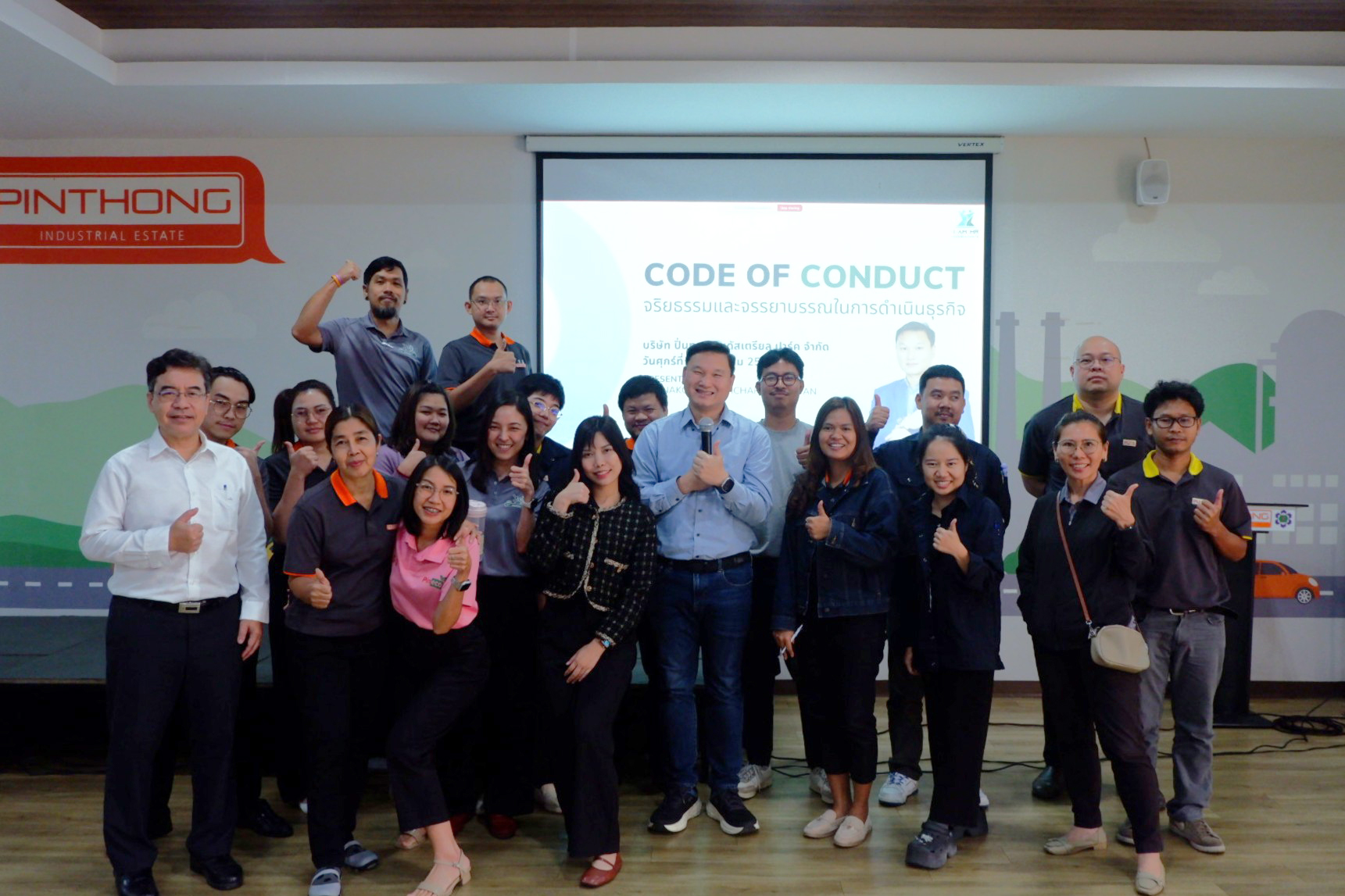
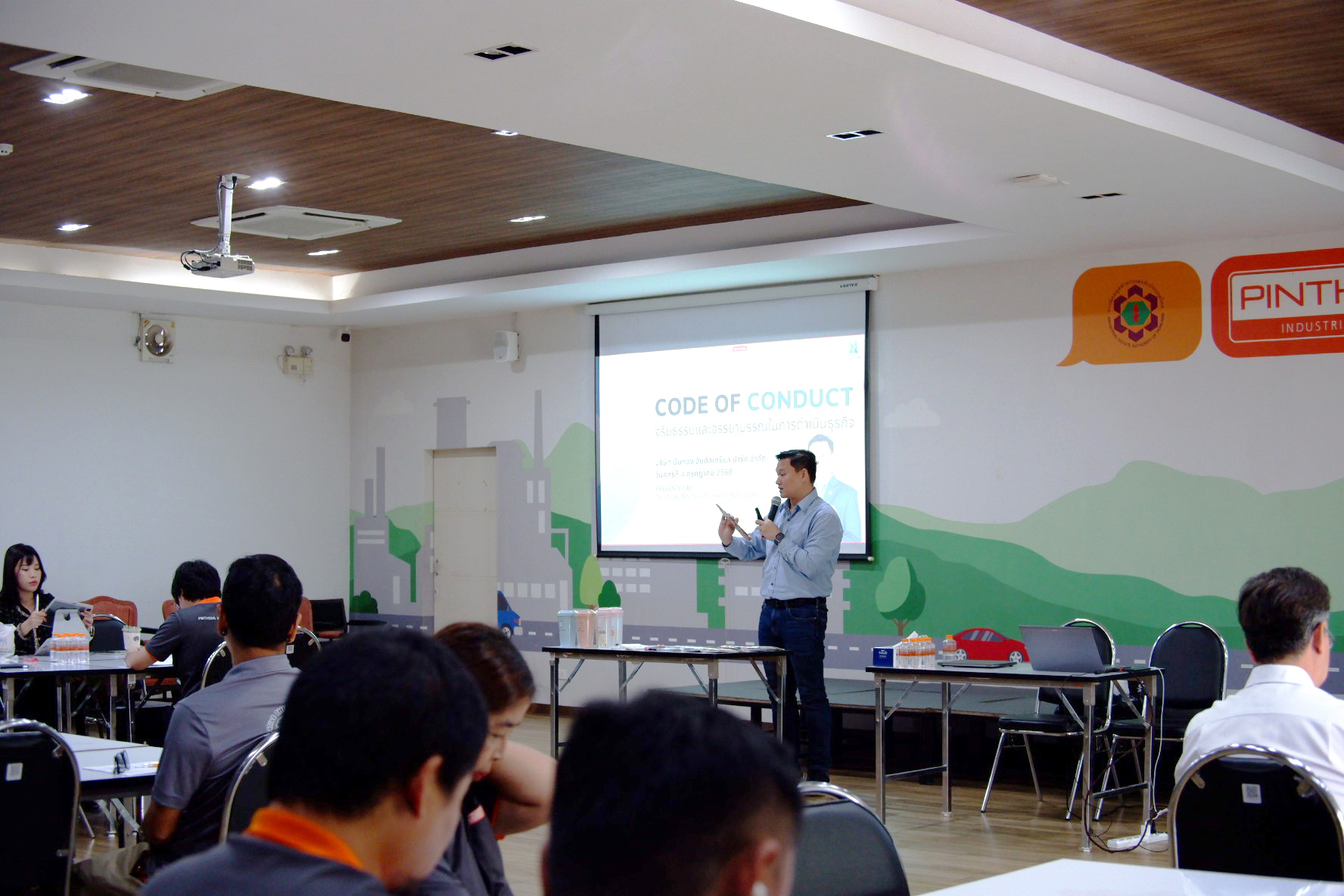

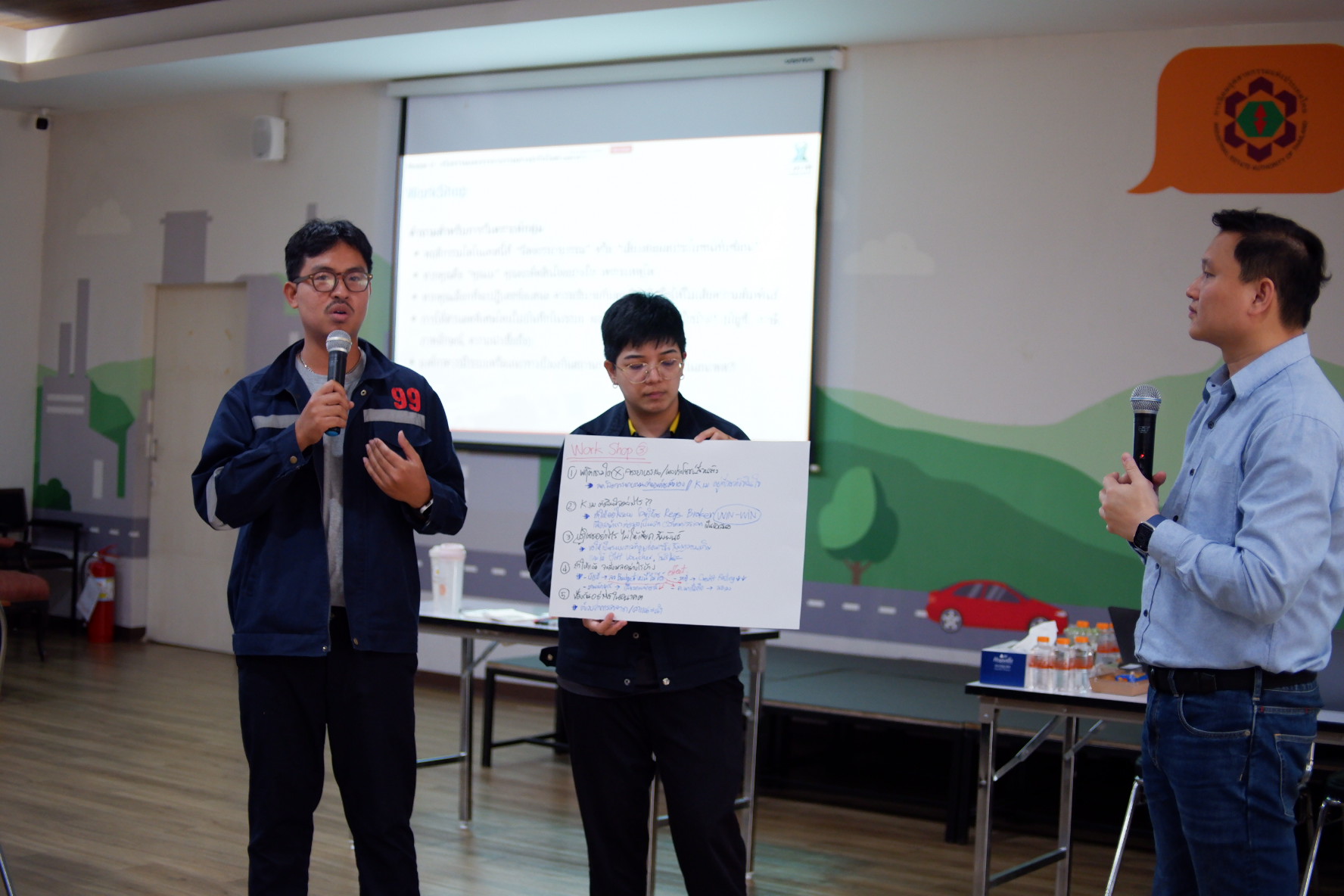
In addition to communicating the Anti-Corruption Policy and Code of Conduct to internal personnel, the Company also communicates to suppliers and contractors via electronic systems (Email), as well as through the company website, annual report, and sustainability report, to inform them of the Company's business conduct guidelines. Anti-corruption requirements for suppliers and contractors are clearly defined in relevant policy documents and in the Supplier Self-Assessment Questionnaire (SAQ) as a tool to assess and monitor compliance, to build mutual understanding and promote ethical, transparent, and auditable business operations.
In 2025, all of the Company's suppliers and contractors completed the Supplier Self-Assessment Questionnaire (SAQ) and signed to acknowledge the Supplier Code of Conduct, which contains the Company's anti-corruption practices, totaling 183 suppliers or 100% of all suppliers.
No Gift Policy
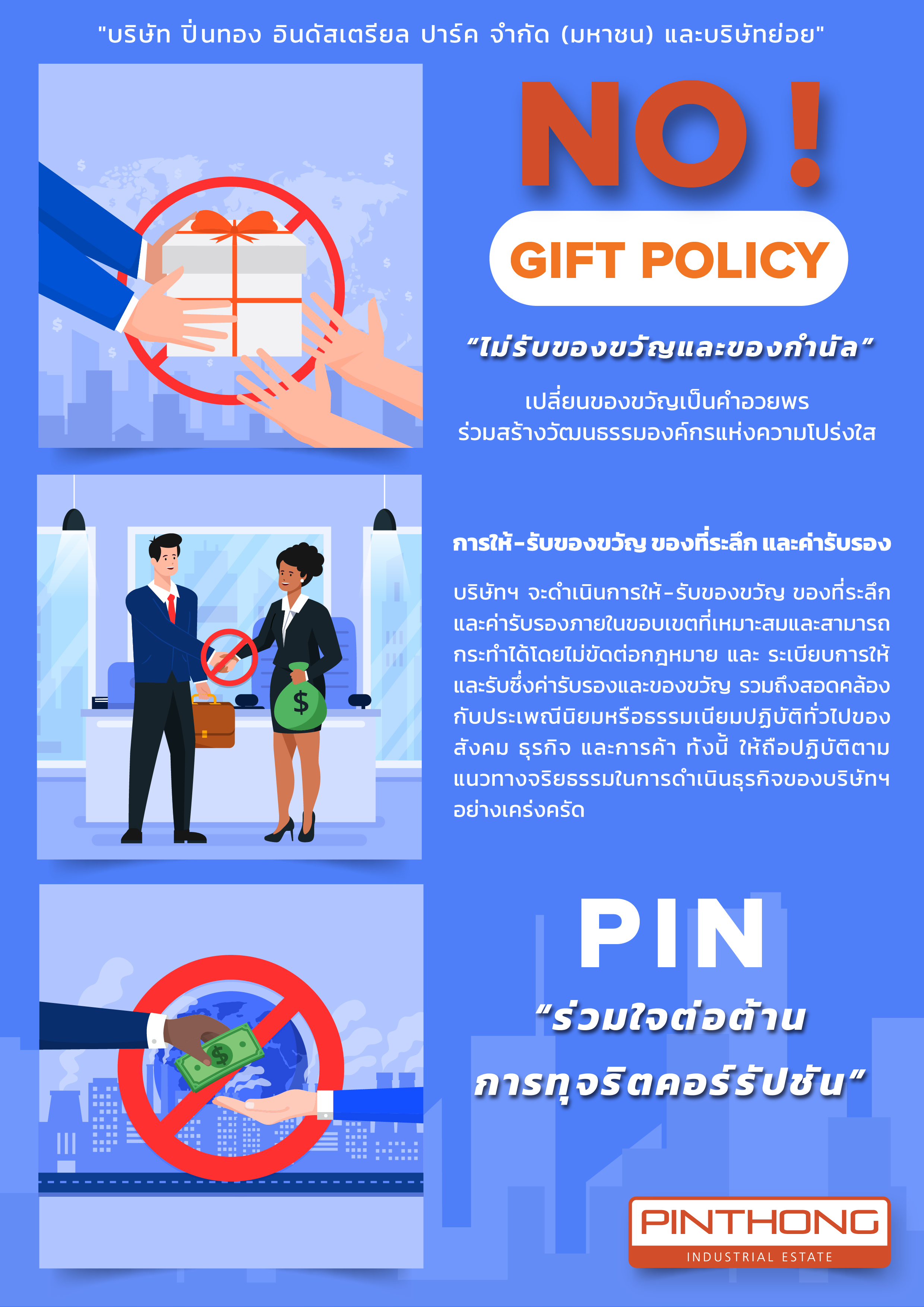
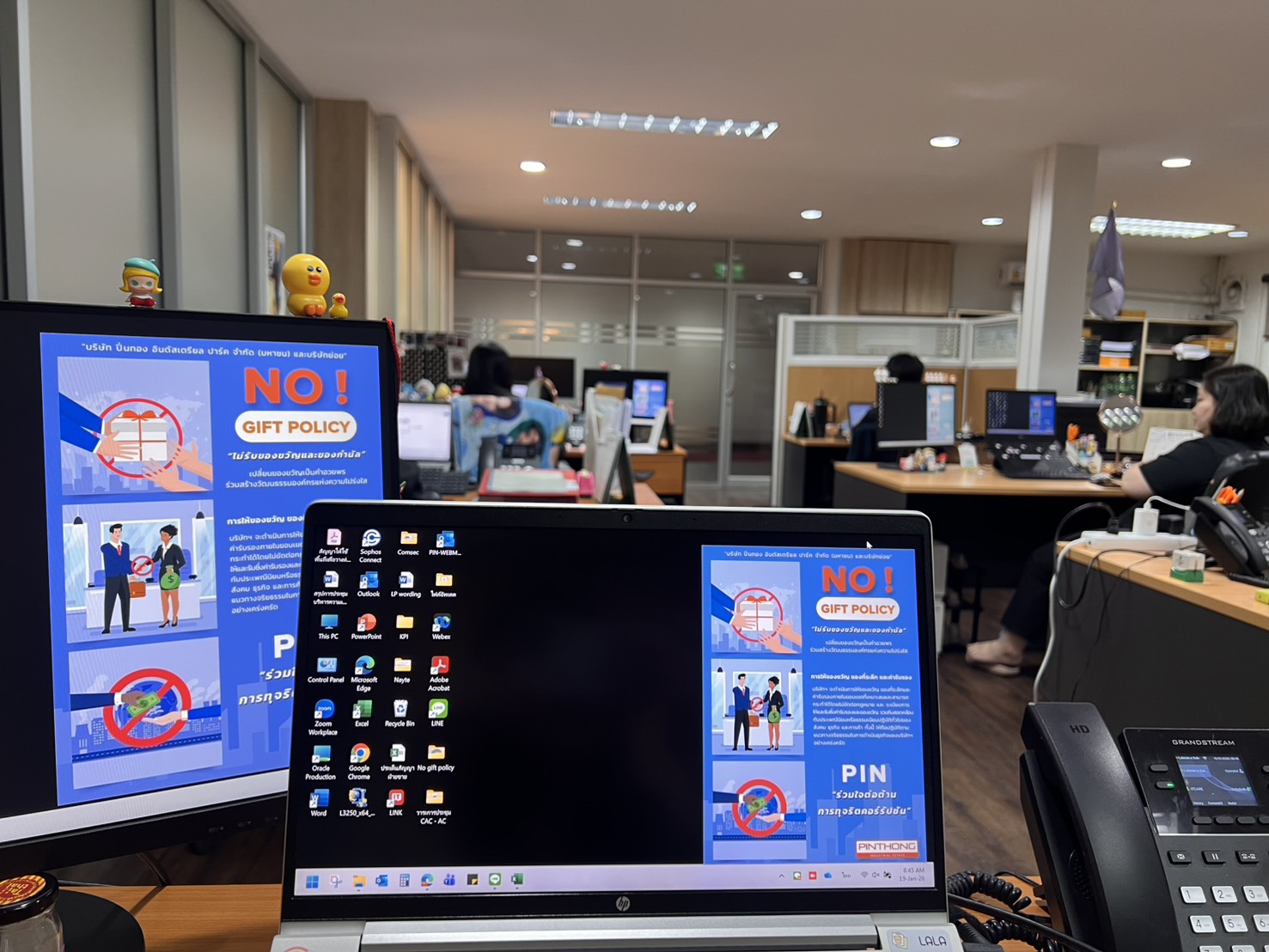
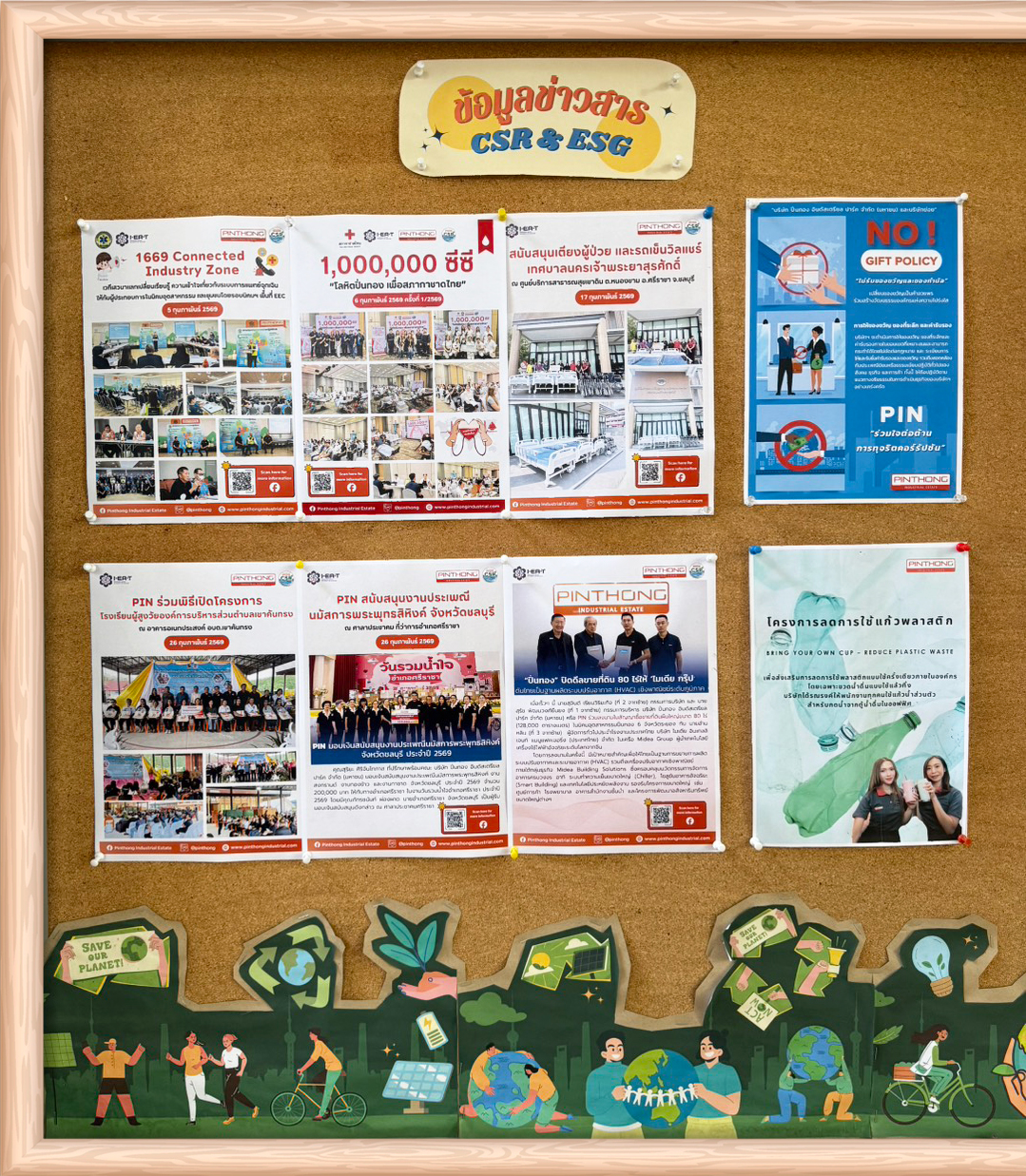
In 2025, the Company conducted a "No Gift Policy" campaign, replacing gifts with good wishes to build a culture of organizational transparency during the New Year season, reinforcing the Company's commitment to transparent and conflict-free business operations. Communication was carried out through internal public relations media, including campaign posters on company notice boards and promotional banners as computer screensavers for all employees to raise awareness and create daily consciousness. The campaign emphasized the practice of not giving, receiving, or soliciting gifts, souvenirs, or any other benefits in any occasion or situation that may be inappropriate or affect business decisions. Target groups include directors, executives, employees at all levels, and company suppliers, to help reduce corruption risks, strengthen ethical business norms, and cultivate a corporate culture committed to integrity, transparency, and accountability.
Joining the Thai Private Sector Collective Action Against Corruption (CAC)
On December 18, 2025, the Company submitted a declaration of intent to join the Thailand’s Private Sector Collective Action Coalition Against Corruption (CAC). CAC has considered and approved the declaration, and the Company is in the process of preparing and submitting documents for CAC membership certification. To reflect the Company's commitment to conducting business with integrity, transparency, and strict adherence to ethical principles, the Company has adopted CAC's principles and practices as a framework for establishing and developing anti-corruption policies, measures, and operational processes, covering corporate governance, risk management, internal controls, and communication and training for directors, executives, and employees at all levels. The Company also aims to encourage suppliers to conduct business ethically and transparently to jointly prevent and reduce corruption risks throughout the Company's value chain.
Complaint Management Mechanism
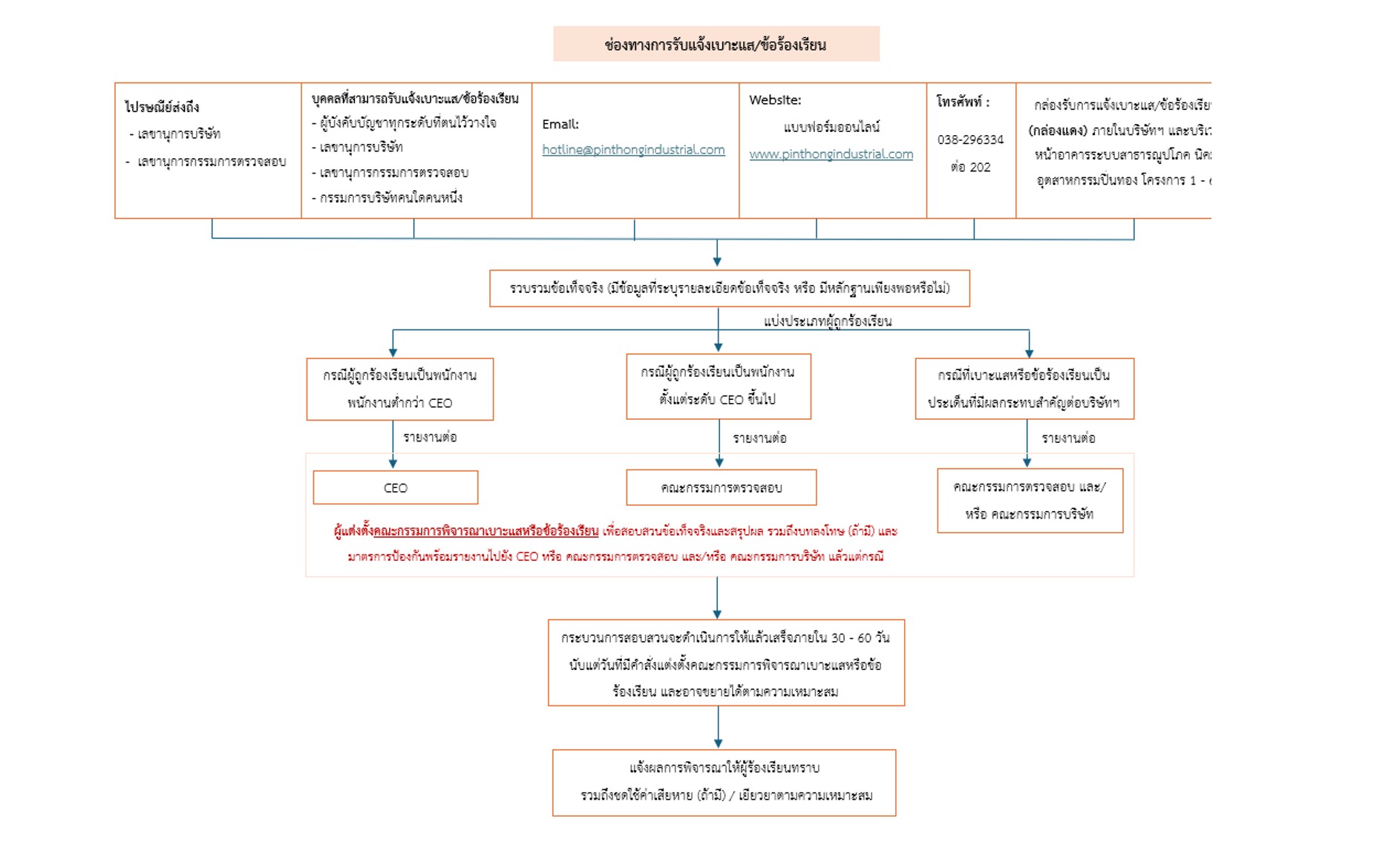
The Company has established a complaint and whistleblowing management process to support good corporate governance and reduce ethics risks, providing employees and stakeholders with the opportunity to report matters to trusted supervisors, the Company Secretary, the Audit Committee Secretary, or any Board member, as appropriate to the complaint issue.
Upon receipt, the Company will collect and screen the facts before entering the investigation process by the assigned person or the whistleblowing/complaint consideration committee, preparing a summary report including penalties (if any) and preventive or corrective measures, submitted to the CEO, Audit Committee, and/or Board of Directors as appropriate, with a completion timeframe of 30-60 days, extendable for complex or serious cases.
The Company protects whistleblowers and complainants by keeping information confidential and preventing unfair intimidation, threats, or harassment under the Personal Data Protection Act. If a false report is found, the Company will act in accordance with relevant regulations or laws. When misconduct is found, the Company will impose appropriate penalties while improving internal control measures and strengthening ethics awareness to prevent recurrence and elevate the organization's governance standards.
Whistleblowing and Complaint Channels
Whistleblowing or complaints can be submitted to any of the designated recipients through the following methods:
| Channel | Details |
|---|---|
| Postal Mail | Company Secretary / Audit Committee Secretary Pinthong Industrial Park Public Company Limited 789 Moo 1 Nong Kho-Laem Chabang Road, Nong Kham, Si Racha, Chonburi 20230 |
| Persons Authorized to Receive Reports | • Supervisors at any level trusted by employees • Company Secretary • Audit Committee Secretary • Any Board Director |
| Hotline@pinthongindustrial.com | |
| Online Form | https://investor.pinthongindustrial.com/th/governance/whistleblowing-form |
| Telephone | 038-296334 Ext. 202 |
| Complaint Box | • Internal complaint box (red box) at the Sales Office building • Internal complaint box (red box) at the Utility building, Pinthong Industrial Park, Projects 1–6 |
In 2025, the Company received one corruption-related complaint involving an employee soliciting commissions in the course of work, which could significantly impact operational efficiency and the Company's reputation. Upon receipt, the Company appointed a whistleblowing/complaint consideration committee to systematically investigate the facts through the established whistleblowing and investigation process, allowing the accused employee to present facts and supporting evidence. The investigation was conducted with care, transparency, and fairness to all parties. The investigation found the conduct to be genuine misconduct constituting a breach of duty and a serious violation of the Company's work regulations, rules, and orders. The Company therefore imposed disciplinary action by terminating the employee in accordance with the established criteria and procedures.
Following the incident, the Company reviewed and strengthened its Internal Control system for greater rigor, while communicating and reiterating the Anti-Corruption Policy and Code of Conduct to employees to raise awareness, prevent recurrence of similar incidents, and elevate corporate governance standards in line with good governance principles and long-term transparency.
| Complaint Type | Number (Cases) | Investigation Result | Disciplinary Action | Prevention of Recurrence |
|---|---|---|---|---|
| Corruption | 1 | Confirmed misconduct | Termination | 1. Review and strengthen internal control measures 2. Communicate and disseminate policies to internal and external personnel 3. Conduct training or provide additional guidance |
| Misuse of Inside Information | 0 | - | - | - |
| Privacy Violation | 0 | - | - | - |
| Human Rights Violation | 0 | - | - | - |
| Harassment and Sexual Harassment | 0 | - | - | - |
| Workplace Environment | 0 | - | - | - |
Environmental, Social and Economic Legal Compliance
The industrial estate business plays an important role in driving the country's economy, particularly Pinthong Industrial Park, located in the Eastern Economic Corridor (EEC) — a central investment area supported by government policy with substantial employment. Business operations therefore involve diverse stakeholder groups including employees, estate entrepreneurs, communities, government agencies, and investors. The Company upholds compliance with environmental, social, and economic laws, regulations, and requirements, such as environmental and pollution control laws, wastewater, air, and waste management, Environmental Impact Assessment (EIA) report conditions, labor and occupational safety laws, as well as business, investment, and tax laws, alongside corporate governance, transparency, anti-corruption principles, and guidelines of the Industrial Estate Authority of Thailand to oversee tenants and operators and minimize impacts on stakeholders. The Company applies the Corrective and Preventive Action (CAPA) principle in accordance with relevant ISO standards to monitor, correct, and prevent cases of potential non-compliance.
To ensure compliance with all relevant laws, the Company has established a governance structure through Management Governance to effectively oversee, monitor, and track operations as follows:
| Responsible Unit | Roles and Responsibilities |
|---|---|
| Board of Directors | Set policies, vision, and direction for legal compliance; oversee and advise management to ensure operations align with good governance principles and relevant standards. |
| Corporate Governance and Sustainability Committee | Define operational frameworks and review environmental, social, and economic approaches; monitor legal compliance; and recommend policies aligned with the organization's sustainability goals and policies. |
| Management | Translate policies and plans into action; monitor operational performance; and propose continuous improvement approaches. |
| Corporate Governance and Sustainability Working Group | Drive, coordinate, and monitor legal changes and operational-level compliance; report progress and key issues to management. |
| Relevant Departments | Monitor legal changes relevant to their department; provide information; implement measures within their scope of responsibility; and report performance results to ensure compliance with laws and Company policies. |
Legal Compliance Monitoring
- Environmental Impact Assessment (EIA) reporting twice a year
- Periodic operational performance reporting to management, and immediate reporting upon identifying issues that may impact business operations or stakeholders
- Developing Corrective and Preventive Action (CAPA) plans to address non-compliance issues and reduce the likelihood of recurrence
- Receiving complaints and suggestions from tenants, communities, and external stakeholders to use as information for continuous operational improvement
Strategy and Management
The Company defines strategies and operational approaches for compliance with laws related to the environment, society, and economy to prevent and reduce risks, as well as manage potential impacts from non-compliance. The focus is on a Preventive Approach alongside monitoring, evaluation, and process improvement, as follows:
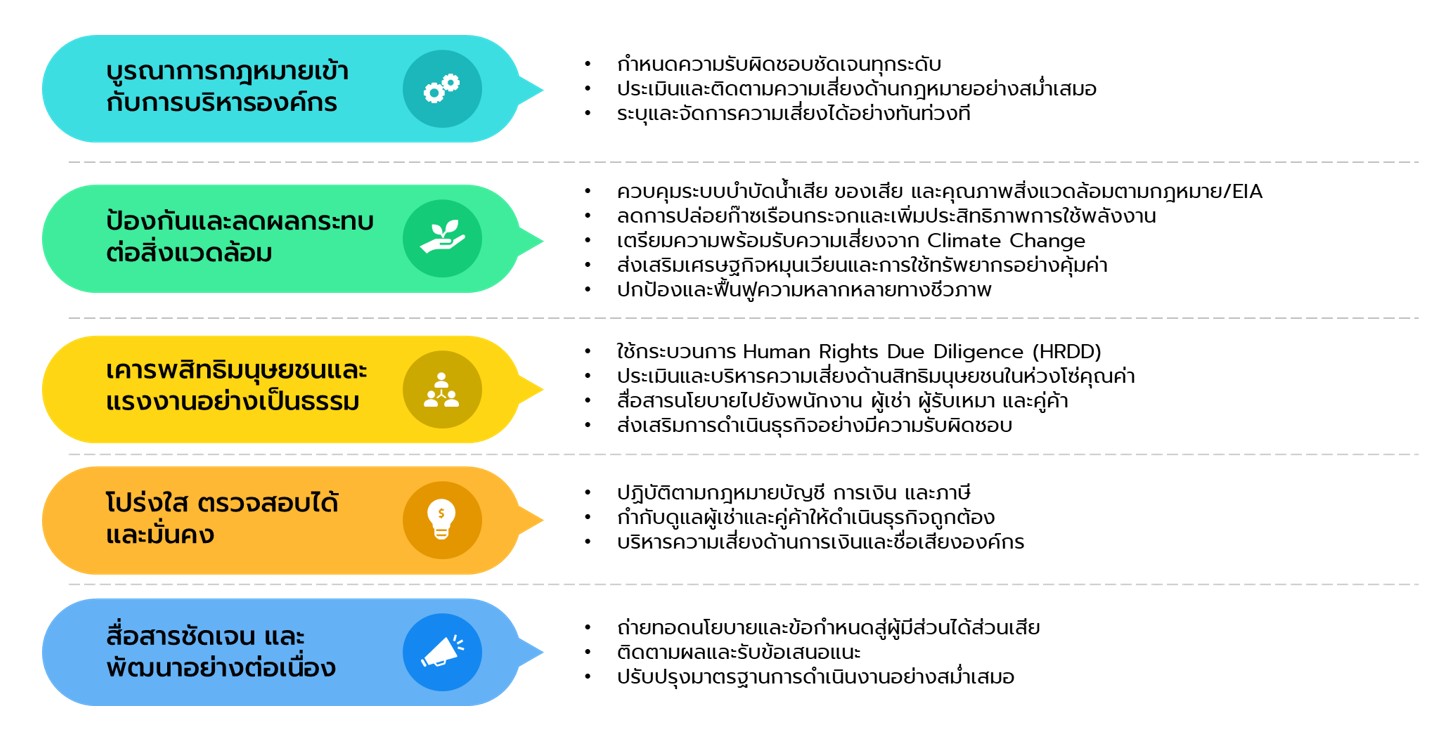
In 2025, the Company found no cases of violation of relevant laws or regulations, and there were no fines, prosecutions, or compensation payments resulting from non-compliance.