Water Management
Managing water resources efficiently for long-term water security and sustainability
Water ManagementMateriality Level : High


Targets and Performance
| Indicator | Long-term Target 2030 |
Target 2025 |
Performance 2025 |
|---|---|---|---|
| Share of reused treated water to total treated water volume | More than 20% |
More than 15% |
15.83%1 |
| Share of raw water use from on-site storage ponds to total water use | At least 50% |
At least 40% |
45.71%2 |
Notes :
1/ Data as of 31 December 2025
2/ Data as of 31 December 2025
Risks and Opportunities
Ineffective water management — across water sourcing, efficient use, and wastewater treatment to standards — may create multi-dimensional risks to industrial estate operations, including rising utility costs, potential disruption of services to operators, and reduced investor and stakeholder confidence. It may also lead to complaints and concerns from surrounding communities, as well as environmental impacts from contamination of natural water sources, ecosystem degradation, and increased GHG emissions — all of which affect the competitiveness and credibility of the industrial estate.
At the same time, applying knowledge, technology, and innovation in systematic water management increases resource efficiency, reduces costs, and strengthens utility security — key factors in enhancing competitiveness and attracting sustainability-minded investors. It also creates shared value with stakeholders by improving the quality of life for communities and operators in the area, supporting the conservation of natural water sources, reducing GHG emissions, and preserving biodiversity — the essential foundations of sustainable industrial estate development.
Strategy and Management
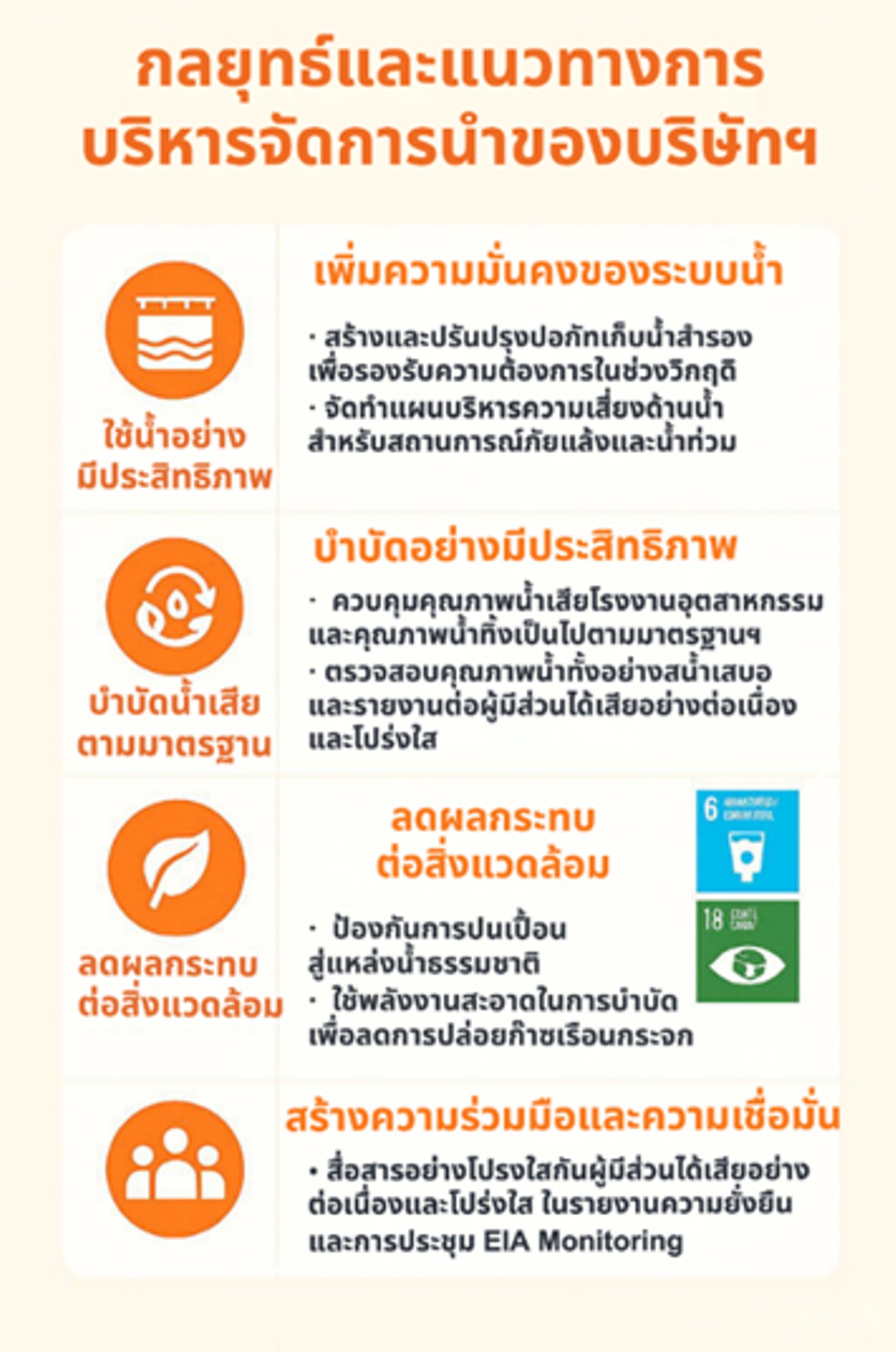
The Company recognizes the importance of water resources as a fundamental factor supporting business continuity and sustainable development. We are committed to effective water management covering sourcing, expanding storage ponds to strengthen water security, efficient water use, wastewater treatment to relevant standards, and reducing reliance on surface water through treated water reuse — to prevent and minimize economic, social, and environmental impacts.
The Company has established water management as a key policy under the Environmental and Climate Change Policy, strictly adhering to relevant laws and regulations — including the Enhancement and Conservation of the National Environmental Quality Act B.E. 2535 (1992), the Factory Act B.E. 2535 (1992), and effluent discharge standards for factories, industrial estates, and industrial zones under the Notification of the Ministry of Natural Resources and Environment B.E. 2559 (2016) — as well as the ISO 14001 Environmental Management System. Operations are also aligned with the Sustainable Development Goals, particularly SDG 6 (Clean Water and Sanitation) and SDG 12 (Responsible Consumption and Production).
The Company continuously and transparently communicates its intent, policies, and water management approaches to operators and stakeholders through key channels such as EIA Monitoring meetings and disclosure in the Sustainability Report — fostering cooperation in responsible water use, supporting the ESG framework, and creating shared value with stakeholders.

Governance Structure
The Company has assigned the Utility Service Manager to be responsible for overseeing water management across all Pinthong industrial estates, reporting to the Executive of the Environment and Water System Division and the Board of Directors respectively. The EIA Monitoring Working Group monitors compliance with environmental requirements and presents the EIA Monitoring Report to government agencies and stakeholders every 6 months.
| Responsible Party | Roles and Responsibilities |
|---|---|
| Board of Directors | Oversees direction, policy, and key issues on the Company's water management, and acknowledges risks, performance, and material issues to ensure alignment with corporate goals and sustainable development direction. |
| Corporate Governance and Sustainability Committee | Reviews and monitors plans, targets, performance, and risk issues in water management, and provides recommendations to management before reporting to the Board of Directors. |
| Chief Executive Officer | Approves plans, key projects, and budgets for water management, and directs operations to align with corporate goals, relevant laws, and sustainable development direction. |
| Chief Operating Officer | Translates policies and strategies into water management action plans, oversees relevant units, and monitors performance, risk management, and readiness of the water system to meet targets. |
| Environment and Water System Division | Responsible for water sourcing and production, water quality control, wastewater treatment, effluent discharge control, system efficiency monitoring, data collection and analysis, and performance reporting. |
| Utility Service Manager | Reviews and proposes investment plans, system improvement plans, and water risk management measures; controls utility system operations to ensure efficient availability and support operator needs. |
| Environmental Manager | Oversees compliance with environmental requirements related to water management, monitors performance, assesses non-conformities and risks, proposes improvements, and coordinates communication with regulators and stakeholders. |
| Department Head | Controls daily operations, ensures compliance with procedures, laws, and relevant standards, identifies issues, reports abnormalities, and proposes corrective or improvement actions. |
| EIA Monitoring Working Group | Monitors and verifies compliance with environmental measures and conditions related to water management, consolidates data for reporting to government agencies, and follows up on corrective actions when deviations are found. |
In addition to establishing a clear governance structure, the Company has implemented a continuous monitoring and evaluation system for water management through mechanisms covering both oversight and disclosure. Water quality inspections are conducted monthly and reports are prepared in accordance with legal requirements to control and prevent potential impacts on the environment and surrounding communities. This is complemented by EIA Monitoring meetings held twice a year to review performance, acknowledge concerns, and define appropriate corrective actions.
In addition, water management performance is reported to management and communicated to stakeholders through the Sustainability Report and internal communication channels on a regular basis, to support transparency and participation from all sectors. External parties are also engaged to verify the accuracy and credibility of data and compliance with relevant standards, ensuring that operations align with laws, relevant requirements, and defined environmental standards.
To ensure efficient water and wastewater management aligned with laws, regulations, and corporate policies and goals, the Company has established the following strategies and operational approaches:
Water Risk and Development of Reserve Water Sources for Industrial Use
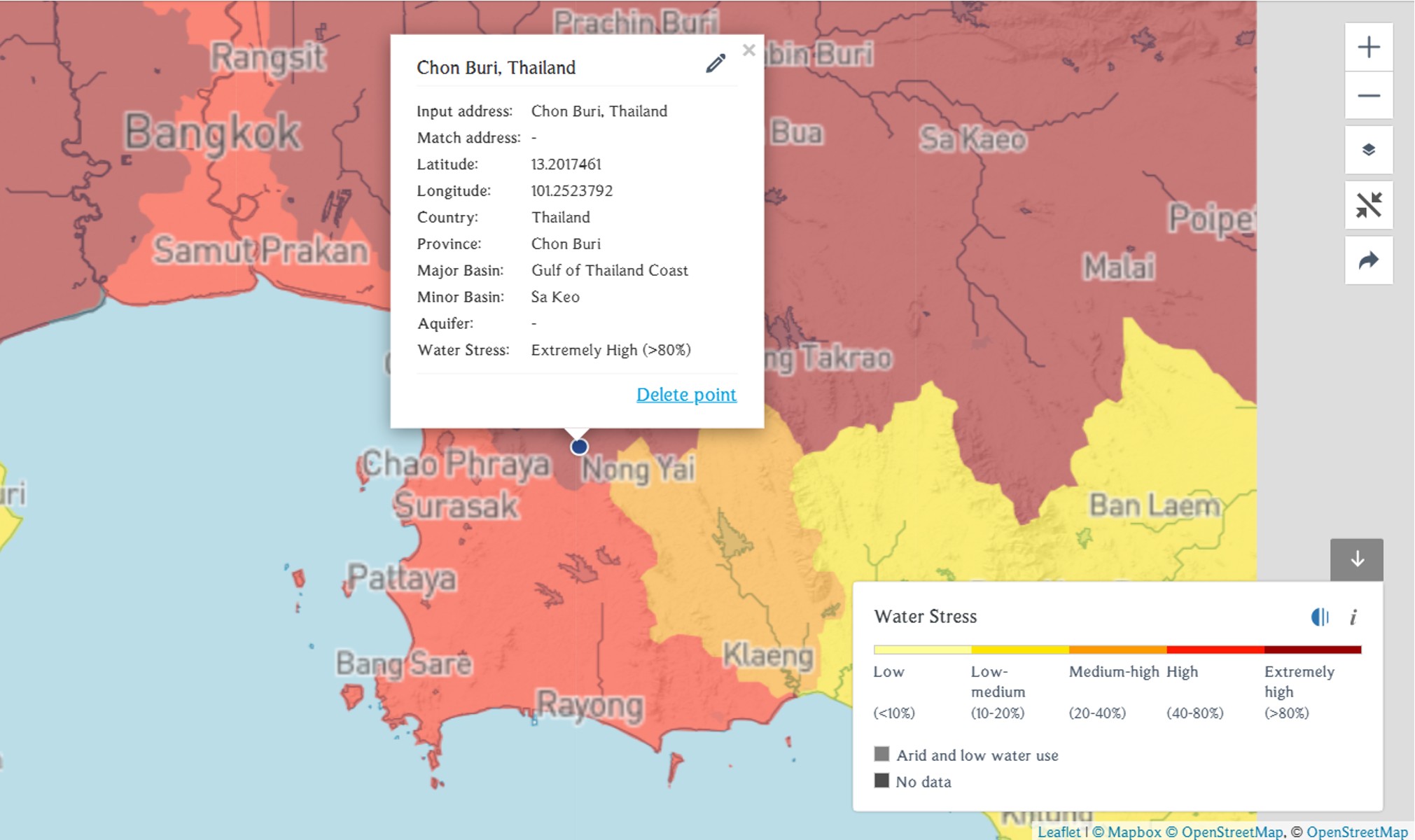
The Company has assessed water risks for its operational areas using the Aqueduct Water Risk Atlas tool developed by the World Resources Institute (WRI) — an international tool for analyzing water resource risks. The assessment found that Chonburi Province, where the project is located, falls within an area of Extremely High Water Stress (greater than 80%), reflecting limited water resource availability and risks from water shortages and future droughts. Given that business operations require large volumes of water in production processes, the Company applies these assessment results to establish measures for continuously strengthening water security.
In 2025, the Company developed reserve water sources within the project area to support industrial water use, with a total raw water storage capacity of 1.77 million cubic meters — unchanged from the previous year — sufficient to meet project water demand for approximately 2 years in the event that external water sources cannot be secured. In addition, raw water from on-site storage ponds has been used in tap water production, reducing water withdrawal from communities and natural sources by 2 million cubic meters, or 46% of total water used in production — helping reduce water-use competition with communities and strengthening long-term water security.
| Reserve Water Source by Project | Unit (Cubic Meters) | Number of Days |
|---|---|---|
| Pinthong Industrial Park | 124,400 | 20 |
| Pinthong Industrial Park (Laem Chabang) | 347,600 | 80 |
| Pinthong Industrial Park (Project 3) | 221,900 | 80 |
| Pinthong Industrial Park (Project 4) | 483,300 | 320 |
| Pinthong Industrial Park (Project 5) | 141,500 | 50 |
| Pinthong Industrial Park (Project 6) | 450,000 | 180 |
| Total | 1,768,700 | 730 |
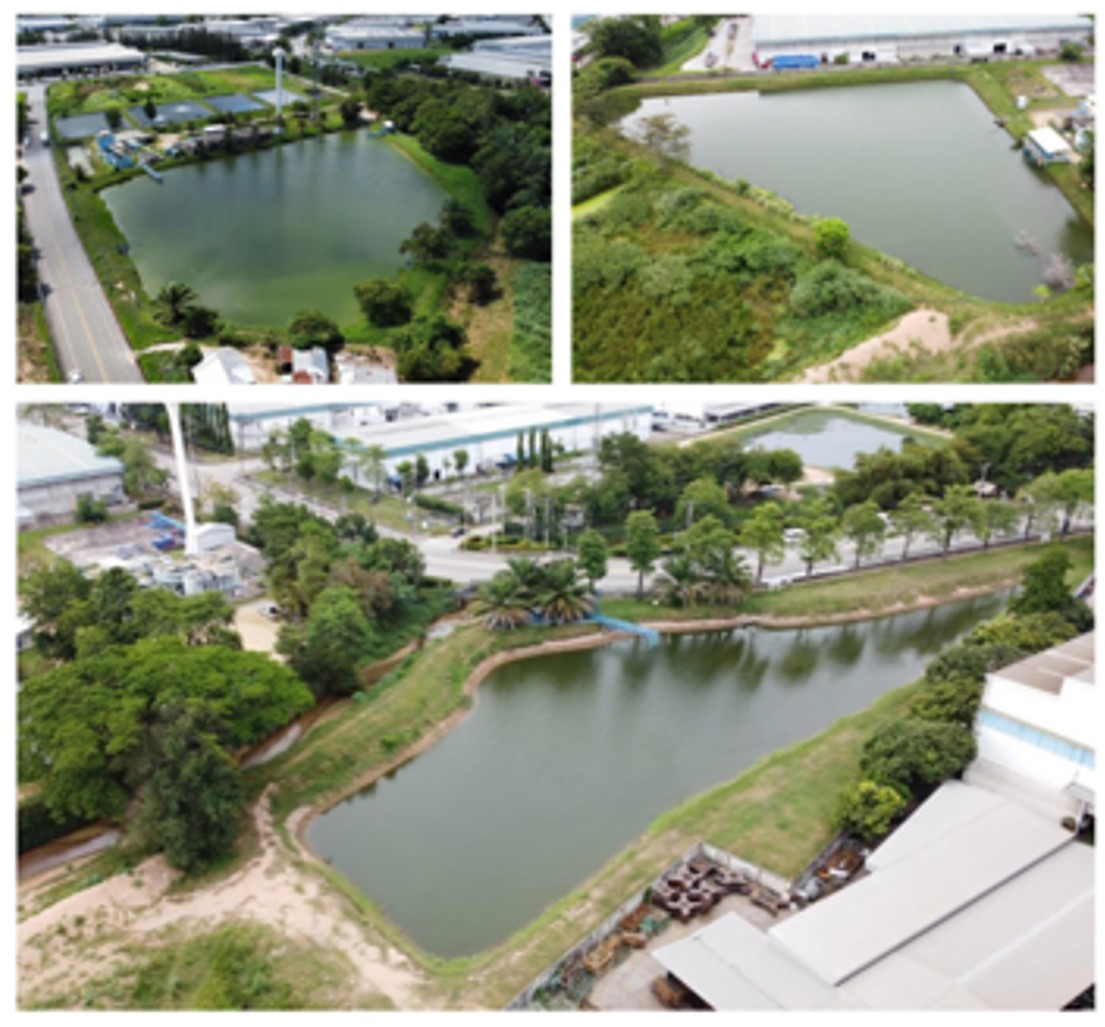
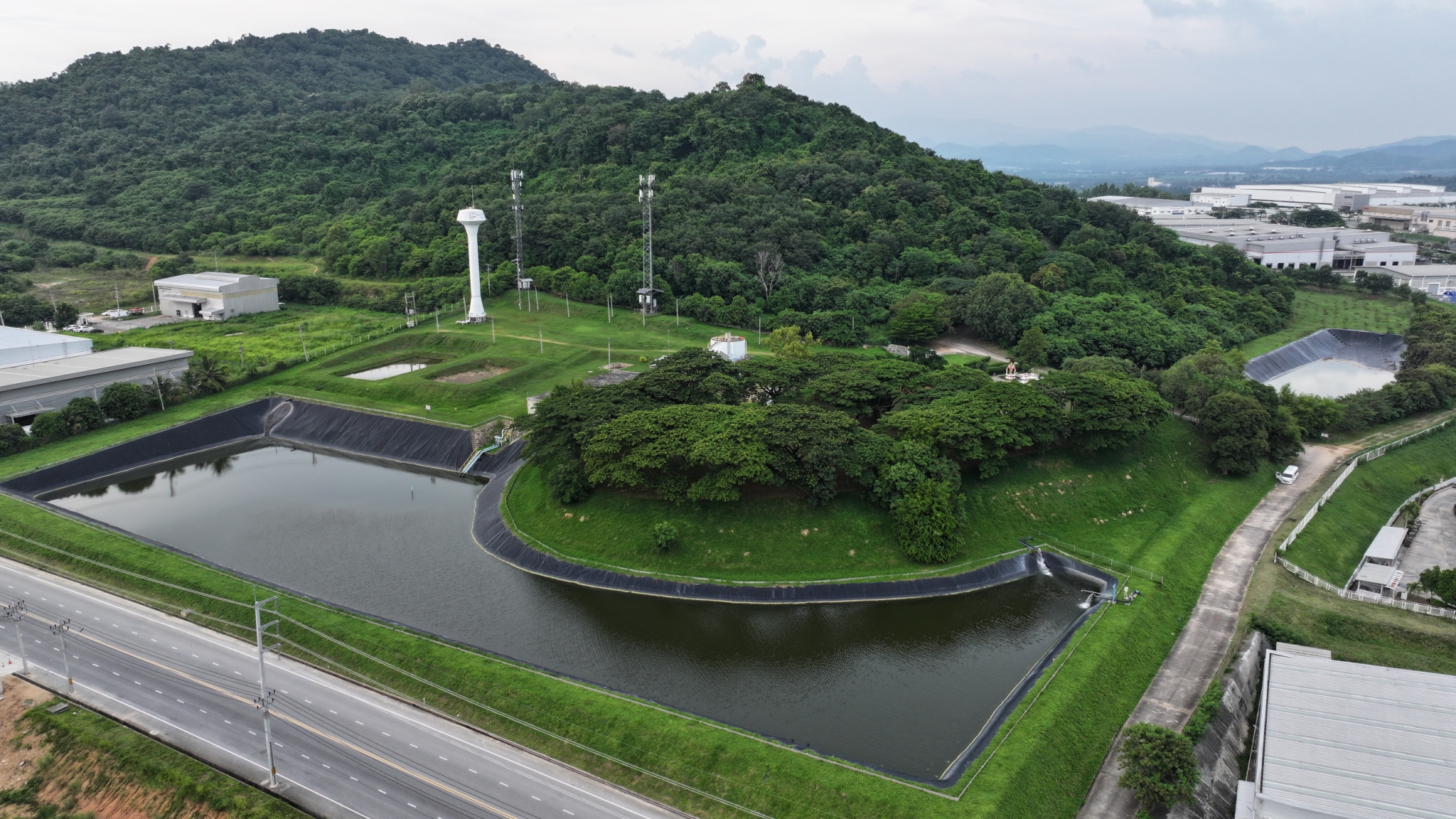
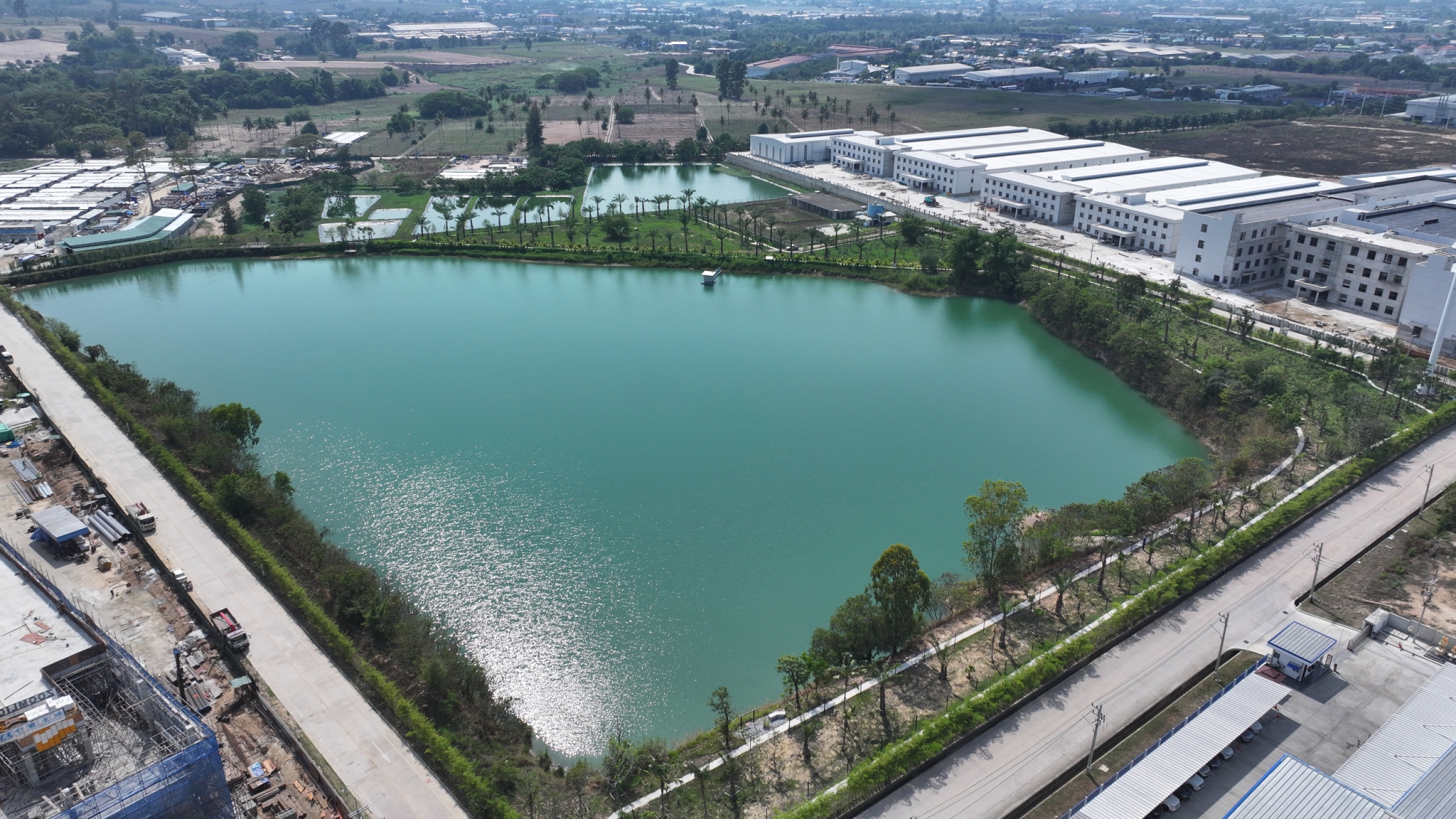
In 2025, the Company withdrew water classified by source as follows:
| Item | 2566 | 2567 | 2568 |
|---|---|---|---|
| Total Water Withdrawal (m3) | 3,330,000 | 3,911,000 | 4,586,773 |
| ● Surface Water (m3) | 2,140,000 | 1,975,000 | 2,096,569 |
| ● Groundwater (m3) | - | - | - |
| ● Seawater (m3) | - | - | - |
| ● Water Purchased from External Suppliers (m3) | 1,190,000 | 1,936,000 | 2,490,204 |
Notes : Data as of 31 December 2025
In 2025, the Company's total water withdrawal amounted to 4,586,773 cubic meters. Water is a key resource and primary raw material for providing utility services to operators within the industrial estates. The Company sourced 2,096,569 cubic meters from surface water (the Company's rainwater retention ponds) and 2,490,204 cubic meters from external suppliers, representing 45.71% and 54.29% respectively. Total water use in 2025 increased by 17.28% from 2024, driven by industrial estate development and growth in economic activities within the area, with new operators entering and existing operators expanding their production capacity, resulting in higher water demand for production processes and supporting activities.
Water Withdrawal by Source in 2025
Improving Water Use Efficiency
The Company focuses on efficient water management by applying the 3Rs approach (Reduce–Reuse–Recycle) alongside innovation and technology in utility systems and services provided to operators within the industrial estate.
Water Use Reduction (Reduce)
Office Water Use Reduction
The Company reduces office water use by defining operational approaches that focus on controlling water use in daily activities, minimizing unnecessary losses, and promoting appropriate water resource use through the following actions:
●Inspect leaks and repair immediately : Regularly inspect equipment such as faucets, toilets, and office water pipe systems, identify leaks that may cause unnecessary water loss, and carry out immediate repairs when abnormalities are found.
●Install water-saving equipment : Select equipment that helps control water use, such as dual-flush toilets and automatic push faucets in restrooms and common areas, to reduce excessive water use and improve water-use efficiency.
●Improve cleaning methods : Reduce water use from hoses by switching to buckets, mops, or low-pressure equipment, and refine cleaning procedures to use less water while maintaining cleanliness and efficiency.
●Promote water conservation : Post communication signs in common areas such as restrooms and kitchens to raise employee awareness and encourage appropriate water-use behavior.
Water Use Reduction in the Utility System
The Company prioritizes reducing raw water use from external sources and minimizing system water losses by promoting water use from the Company's storage ponds, along with reusing treated water for appropriate activities such as blending as raw water for tap water production, plant watering, and cleaning — while closely monitoring and controlling water use to reduce leakage and inefficient consumption.
Real-Time Water Monitoring System Project
The Company initiated this project to enhance water resource management efficiency, reduce reliance on external raw water purchases, and strengthen the water security of the industrial estate. Digital technology and sensor systems are installed in storage ponds and water distribution systems to continuously monitor remaining raw water volumes and flow rates in real time, covering Pinthong Industrial Park, Pinthong Industrial Park (Project 5), and Pinthong Industrial Park (Project 6). The data enables the Company to appropriately control raw water use in storage ponds, rapidly detect abnormalities in distribution systems before cumulative losses occur, and assess water demand trends and reserve volumes to effectively plan for water shortage scenarios. The data is also used in monitoring and reporting key water indicators such as raw water consumption and tap water delivered within the industrial estate.
As a result of all these actions, the Company reduced raw water purchases from private suppliers by 2,413,804 cubic meters per year, or 52.63% of total water withdrawal — reducing raw water procurement costs by approximately 29.24 million baht per year.
Reduction in Raw Water Purchased from Private Sector
Approximate Reduction in Raw Water Procurement Costs
Recycling and Reusing Treated Water (Recycle & Reuse)
The Company reuses water that has been treated and meets quality standards to replace raw water in general activities that do not require high-quality water, such as plant watering, washing roads and public areas, and cleaning within the industrial estate — covering Pinthong Industrial Park 1, Pinthong Industrial Park (Laem Chabang), and Pinthong Industrial Park (Project 3). The target is to increase the share of reused treated water to no less than 15% of total treated water, in line with eco-industrial estate guidelines — reserving clean water for essential activities, reducing water procurement costs, and decreasing the volume of post-treatment effluent discharged to the environment.
Through this initiative, the Company reused a total of 317,235 cubic meters of treated water — representing 15.83% of total treated water. This includes 285,182 cubic meters (100%) reused at Pinthong Industrial Park (Project 3) under the Zero Discharge approach, and a combined 32,053 cubic meters across other industrial estate areas. The Company plans to develop a Water Recycling system across the industrial estates by 2030 to further increase the share of recycled water in production processes and reduce long-term reliance on external water sources.
Treated Water Reused for Beneficial Use
Effluent Water Quality Control
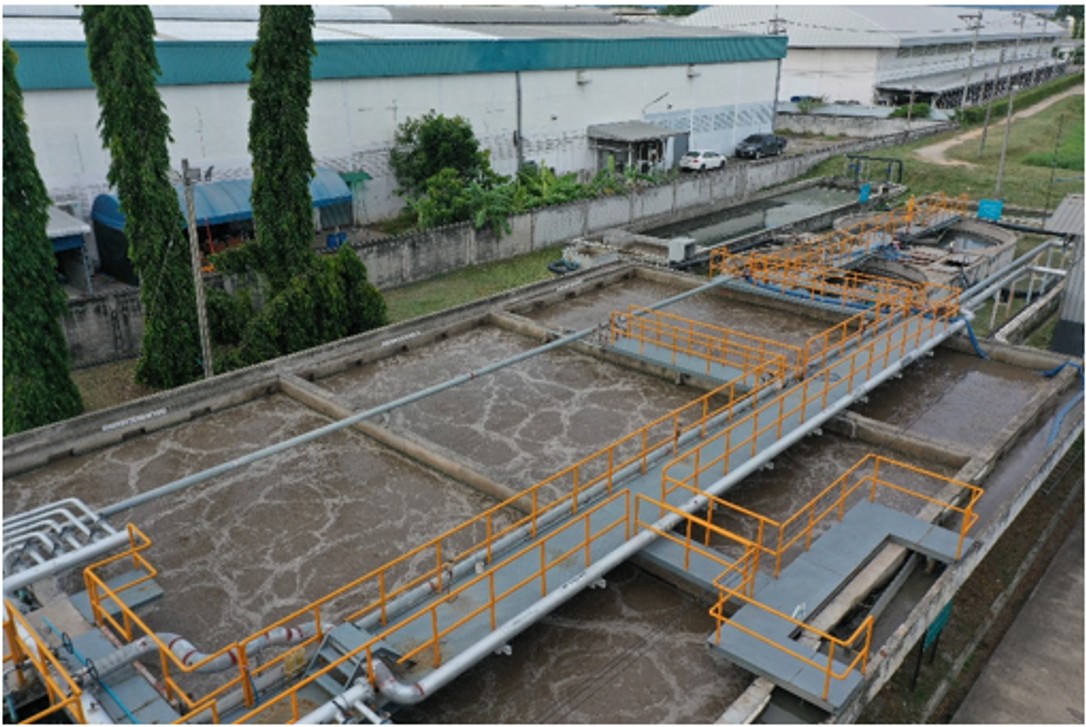
The Company systematically manages wastewater in accordance with laws and environmental standards, while controlling and preventing impacts on communities and ecosystems through the following key processes and measures:
1. Standardized Wastewater Treatment System
●Use wastewater treatment systems designed to standards and engineering principles.
●Control effluent quality to meet legal standards before discharging into natural water sources.
2. Water Quality Monitoring and Reporting
●Inspect wastewater discharged from factories monthly in accordance with legal requirements, to control non-standard discharge at the source.
●Inspect effluent quality after treatment monthly as required by law.
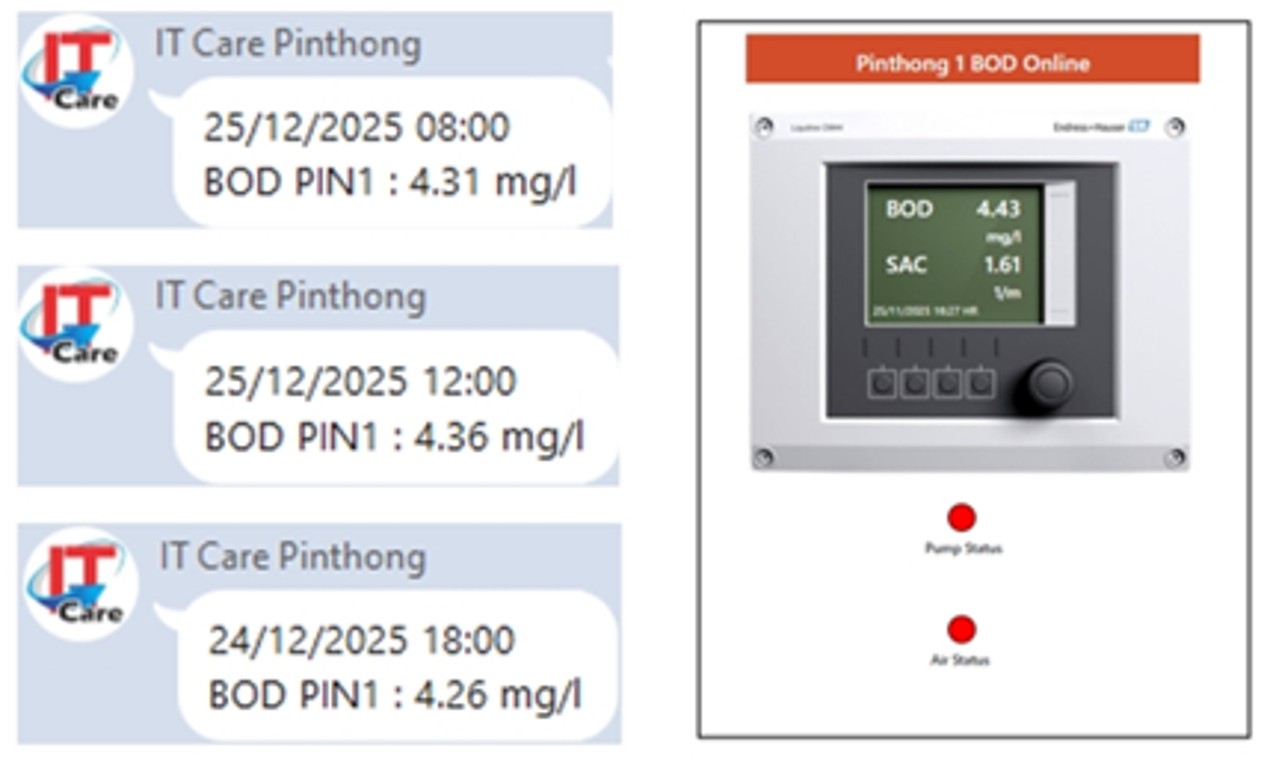
●Install online sensor systems for monitoring treated effluent quality (Online Monitoring) including BOD, COD, and TDS, to control effluent standards and increase reporting transparency.
●Prepare inspection reports and disclose them to government agencies and stakeholders transparently.
3. Contamination Prevention Measures
●Inspect wastewater at risk of heavy metal and chemical contamination, and require factories with chemical wastewater treatment systems to have emergency retention ponds to prevent leakage.
●Regularly inspect wastewater collection pipes and effluent holding ponds to reduce contamination risks.
4. Monitoring and Reporting Mechanism
●Hold EIA Monitoring meetings with government agencies and stakeholders twice a year to track performance.
●External inspection (EIA Audit) to verify transparency and compliance with measures and requirements specified in the Environmental Impact Assessment (EIA Report).
5. Use of Technology
●Install solar-powered aeration turbines in post-treatment effluent ponds to increase dissolved oxygen in the water.
●Develop digital systems for online reporting of water quality inspection results.
| Detail | Pinthong Project (1) |
Pinthong Project (2) |
Pinthong Project (3) |
Pinthong Project (4) |
Pinthong Project (5) |
Pinthong Project (6) |
|---|---|---|---|---|---|---|
| Wastewater Treatment System | Aerated Activated Sludge (MBBR + AS) | Aerated Lagoon (AL) | Aerated Lagoon (AL) | Aerated Lagoon (AL) | Aerated Lagoon (AL) | Aerated Activated Sludge (SBR) |
| Capacity (m³/day) | 4,000 | 3,946 | 3,400 | 1,150 | 2,500 | 2,000 |
| Average Inflow1/ (m³/day) | 2,750 | 1,500 | 713 | 420 | 899 | 5002/ |
| Number of Factories | 163 | 84 | 76 | 12 | 28 | 11 |
Notes :
1/ Average wastewater data as of December 2025
2/ Wastewater inflow began in October 2025
Installation of Wastewater Flow Meters and Online Effluent Quality Sensor System
The Company has adopted an online wastewater quantity and quality monitoring system as a key tool for controlling and safeguarding the performance of wastewater treatment systems at Pinthong Industrial Park, Pinthong Industrial Park (Laem Chabang), and Pinthong Industrial Park (Project 5). Flow Transmitters are installed to measure wastewater inflow and outflow, alongside sensors that continuously monitor post-treatment effluent quality in key parameters — BOD, COD, and TDS — via a digital system, with automatic alerts linked through LINE Application so that system operators can immediately identify abnormalities and take corrective action. The system enables close monitoring of treatment load and effluent quality against legal standards, reduces process variability, and proactively prevents the risk of substandard discharge. Data from the system can also be used to analyze trends, improve operational efficiency, and support transparent, traceable reporting to regulatory authorities.
In 2025, the Company achieved full compliance with effluent quality standards — with no incidents of BOD, COD, or TDS exceeding legal limits. This reduces the risk of non-compliance with legal requirements, minimizes potential costs from emergency incidents, and strengthens confidence among government agencies, communities, and stakeholders in the industrial estate's water pollution management performance.
Installation of Solar-Powered Aeration Turbines in Effluent Holding Ponds
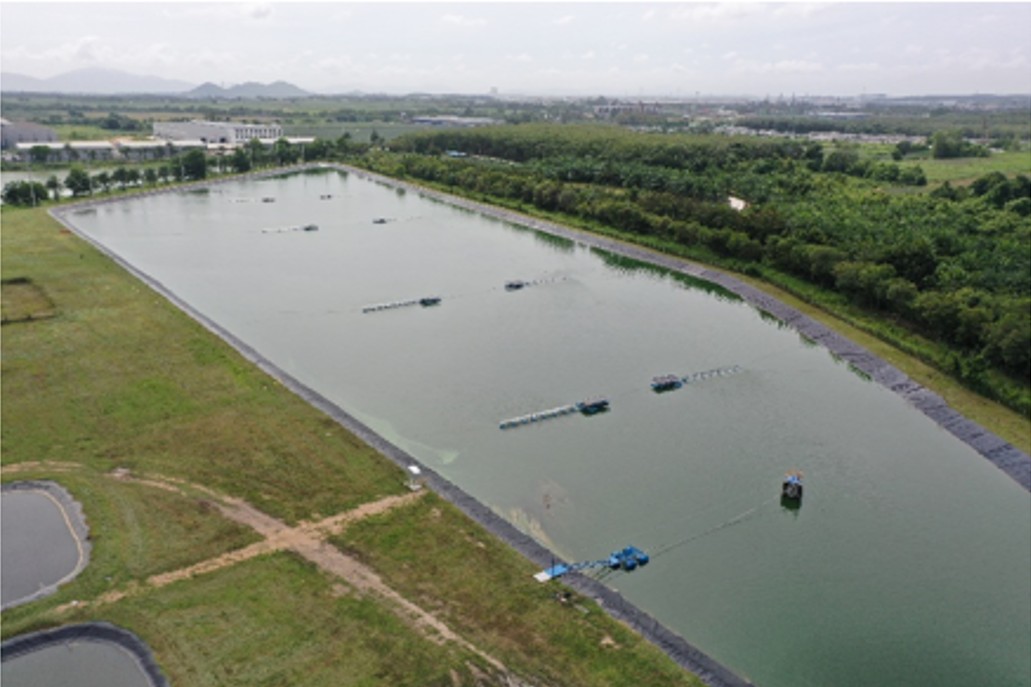
The Company installed solar-powered aeration turbines in effluent holding ponds to improve water quality treatment efficiency alongside the use of renewable energy. Solar energy drives the aeration system to increase dissolved oxygen (DO), a key factor in decomposing organic matter and preventing water stagnation. The solar turbines operate more quietly than conventional aerators such as Jet Aerators or Surface Aerators, causing no noise disturbance to surrounding areas. The project has been implemented at Pinthong Industrial Park, Pinthong Industrial Park (Project 3), and Pinthong Industrial Park (Project 5).
After installation, dissolved oxygen levels increased from 0–1 mg/L to 3–6 mg/L — a level conducive to microbial activity in the treatment system and improving water quality stability. This enables continuous control of water quality in effluent holding ponds, reduces odor, and helps maintain the balance of aquatic ecosystems. At the same time, the use of solar energy reduces electricity consumption from fossil fuels and lowers greenhouse gas emissions.
Effluent Quantity and Quality Data in 2025
| Item | Volume (m3) | ||||||
|---|---|---|---|---|---|---|---|
| Total Treated Water | 2,003,444 | ||||||
| Effluent Discharged to Surface Water | 1,686,209 | ||||||
| Effluent Reused (m3) | 317,235 | ||||||
| Effluent Quality Data | |||||||||||||||||||
|---|---|---|---|---|---|---|---|---|---|---|---|---|---|---|---|---|---|---|---|
| Project | Standard | Project 1 | Project 2 | Project 3 | Project 4 | Project 5 | Project 6 | ||||||||||||
| Year | 2023 | 2024 | 2025 | 2023 | 2024 | 2025 | 2023 | 2024 | 2025 | 2023 | 2024 | 2025 | 2023 | 2024 | 2025 | 2023 | 2024 | 2025 | |
| BOD (mg/L) | ≤20 / ≤16* | 6 | <5 | 5.6 | 8 | 7 | 6.1 | - | - | - | 11* | 9* | 10* | 9* | 14* | 11* | - | - | <5* |
| COD (mg/L) | ≤120 | 41 | <40 | <40 | <40 | <40 | <40 | - | - | - | 82 | 89 | 90 | 48 | 50 | 64 | - | - | 42 |
| TSS (mg/L) | ≤50 | 4.5 | 5.5 | 6 | 4.9 | 7.5 | 5.8 | - | - | - | 26.4 | 35.4 | 33 | 18.5 | 18.4 | 30.4 | - | - | 12 |
Water Management Technology
The Company aims to enhance water resource management efficiency through the application of digital technology and innovation, enabling continuous and precise operational control, reducing non-compliance risks, and improving the ability to monitor, verify, and systematically disclose information to regulatory authorities and stakeholders through the following key initiatives:
SCADA System (Supervisory Control and Data Acquisition)
The Company has adopted a SCADA (Supervisory Control and Data Acquisition) system to control and monitor the operation of tap water production and wastewater treatment systems at Pinthong Industrial Park (Projects 5 and 6), raising water management efficiency through digital technology. The system collects and displays real-time operational data from equipment and processes at a central control center, enabling continuous measurement of key parameters — such as water production rate, raw water levels in storage ponds, water levels in buffer tanks, main pipe pressure, tap water quality (Turbidity, pH, and Conductivity), post-treatment effluent quality, and incoming wastewater volumes — along with precise control of pumps and automatic valves.
Connecting data to the central system allows operators to monitor system status at all times, quickly identify abnormalities, and take corrective action promptly. This reduces water loss, prevents tank overflow, substandard water quality, and machinery failures before they cause serious damage, while improving system stability and safety — and reducing tap water production contracting costs by approximately 3.6 million baht per year. In addition, the SCADA system elevates utility management to a Smart Industrial model that supports efficient, transparent, and traceable environmental operations.
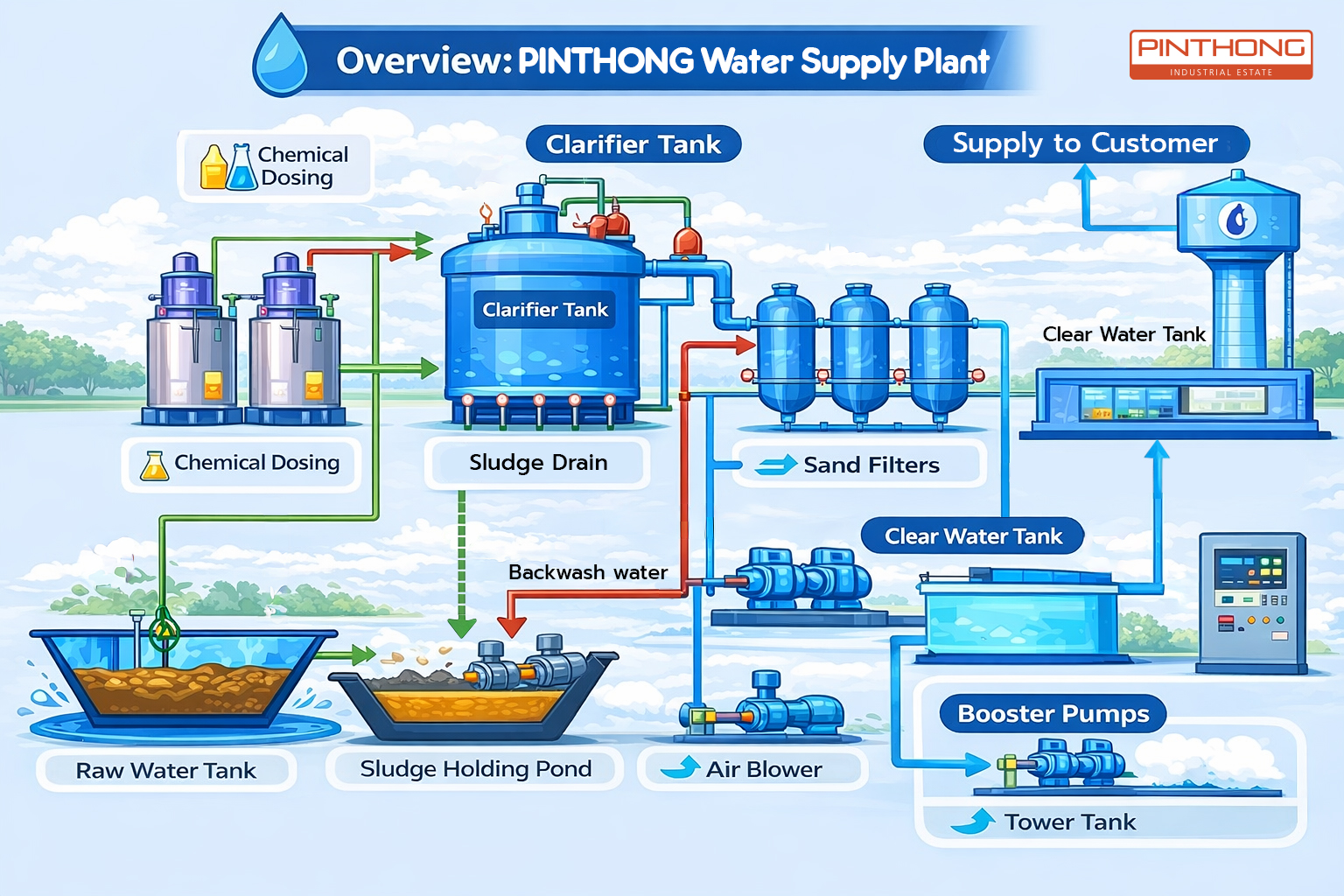
To maximize the efficiency of water resource management in line with sustainable development principles, the Company has continued to expand the installation of its Smart Water Management system to cover every Pinthong Industrial Estate project. This initiative upgrades central utility systems toward a Smart Industrial model that can control and monitor operations and reduce water loss in a tangible way. The current installation progress for each project is as follows:
Engaging Stakeholders in Water Management
Employees
The Company engages employees in water management by promoting knowledge and understanding of efficient water use through educational activities and internal communications, raising awareness of appropriate water use in daily activities. Employees are also encouraged to monitor and report leaks in faucets, toilets, or pipes to the responsible units so repairs can be carried out promptly. The Company has also defined guidelines for appropriate water use in cleaning — asking cleaning staff to avoid hose use that consumes large volumes of water, and to switch to buckets and equipment that better control water use. Communication signs are posted in common areas such as restrooms and kitchens to promote water-saving practices — e.g., closing taps immediately after use, using only necessary amounts, and avoiding running water during use — to encourage employees to collectively care for and use water resources appropriately in the office.
Communities and Government Agencies
The Company prioritizes strengthening water resource security in the area alongside building trust with stakeholders, through continuous projects and measures with communities, local administrative organizations, government agencies, and external partners. Preventive management is achieved through regular inspections of wastewater collection pipes and effluent holding ponds, along with providing Emergency Ponds to handle unforeseen situations — reducing leakage risks and preventing contamination of natural water sources and surrounding communities.
At the same time, the Company promotes participation and transparent information disclosure through EIA Monitoring meetings held twice a year with government agencies, communities, and relevant stakeholders — along with a systematic channel for complaints and suggestions, and joint field sampling of environmental quality with the EIA Committee for participatory data verification. The Company also discloses effluent quality data through the Sustainability Report, online systems, and external audits to confirm compliance with environmental standards and enhance operational transparency.
Operators in the Industrial Estate
The Company supports operators and tenants in the industrial estate to manage wastewater in accordance with laws and environmental standards by providing systematic consulting and solutions when factory effluent quality does not meet the defined criteria. The Company's environmental team conducts on-site preliminary inspections to analyze the root cause, assess wastewater treatment system efficiency, and identify risk points that may affect effluent quality — before recommending appropriate improvements such as production process enhancement and wastewater treatment optimization. This ensures targeted corrective action and reduces the likelihood of recurring issues over the long term.
This support and consulting enables operators and tenants to comply with legal requirements effectively and reduces the risk of penalties or unexpected costs, while playing a key role in preventing impacts on the environment and surrounding communities. It also strengthens stakeholder confidence that the Company has robust environmental support systems capable of elevating operator and tenant operational standards in line with the Sustainable Development Goals (SDGs) — reflecting the Company's role as an industrial estate developer and operator committed to responsible, shared growth with the environment and society.
Complaints Regarding Wastewater Leakage to Areas Outside the Company
The Company continuously prioritizes listening to opinions and concerns from communities and stakeholders by providing accessible and responsive complaint channels — including the Company hotline and Line Official (Line OA) — with systematic processes for receiving, verifying, and resolving issues to respond promptly and transparently.

In 2025, the Company recorded no incidents of untreated wastewater leaking into public areas. However, residents in a community near a public drainage channel made 1 inquiry to the Company about water being discharged during the dry season — treated water released to lower the level of the Company's long-term effluent holding pond for repair of a damaged section. The Company expedited repairs and immediately halted the discharge, provided factual clarification to the nearby community, and arranged for the environmental monitoring committee to conduct on-site sampling of surface water at various points to verify that the discharged water quality met legal standards — ensuring that operations do not affect the environment and community, while continuously communicating the information to stakeholders.
In addition, the Company has established operational guidelines for cases where treated water must be discharged — such as during the dry season — by notifying and coordinating with local authorities and communities in advance, to prevent recurring complaints and foster mutual understanding in the Company's operational areas.