Sustainability Strategy
Strategic framework and approach driving the organization toward long-term sustainability
Strategy for Sustainable Growth
The Company has analyzed high-priority material sustainability assessment results and connected them with its vision and business direction to develop the “R-I-S-E” Strategy — a Sustainability-integrated Business Strategy — with the objective of aligning strategic decisions, risk management, and long-term business development with industry changes, stakeholder expectations, and international sustainable development trends.
This strategic approach enables the Company to link material sustainability topics with economic value creation, efficient resource use, and management of environmental and social impacts — allowing the Company to enhance competitive capability, differentiate from competitors in the same industry, and build stakeholder confidence in a balanced manner.
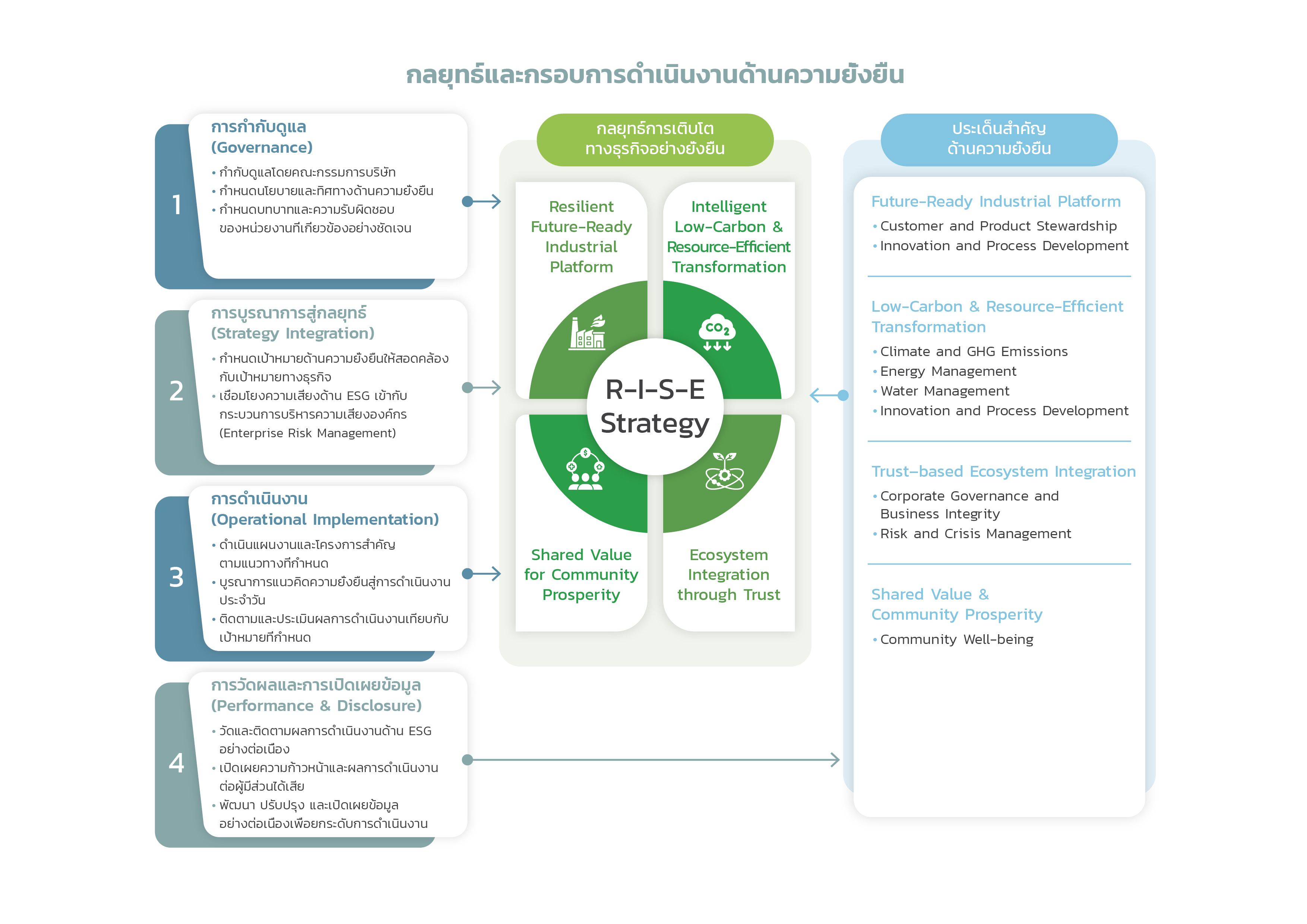
1. Resilient Future-Ready Industrial Platform (R)
Continuously develop and elevate the industrial estate to support future industries, new supply chain models, and evolving regulatory requirements.
| Strategic Goals |
|
| Long-term Targets 2030 |
|
2. Intelligent Low-Carbon & Resource-Efficient Transformation (I)
Elevate operations and utility systems toward becoming a low-carbon industrial estate with efficient resource use, strengthening competitiveness and long-term environmental performance.
| Strategic Goals |
|
| Long-term Targets 2030 |
|
3. Shared Value and Community Prosperity (S)
Create shared economic and social value with communities and stakeholders through responsible estate development, inclusive growth, and proactive relationship-building.
| Strategic Goals |
|
| Long-term Targets 2030 |
|
4. Ecosystem Integration through Trust (E)
Build long-term trust and collaboration with stakeholders in the industrial ecosystem — customers, communities, government agencies, and business partners — with transparency, continuous engagement, and responsible estate development.
| Strategic Goals |
|
| Long-term Targets 2030 |
|
To translate the sustainable business growth strategy into concrete practice, the Company has established a Sustainability Operating Framework linked to all 4 strategic directions, under the concept of developing industrial estates into a Sustainable Industrial City, which views the industrial estate as a place where business growth, people's quality of life and environmental integrity must progress together. The framework covers governance, risk management, target-setting and systematic monitoring, and comprises:
(1) Defining policies and responsibilities at the Board and executive levels to steer direction and prioritize sustainability issues.
(2) Integrating material sustainability topics into business planning, project development, infrastructure and service management, as well as enterprise risk management, taking into account impacts on the industrial estate and surrounding communities.
(3) Setting targets and indicators aligned with material topics across economic, social, environmental and governance dimensions, linked to the performance evaluation of the relevant units.
(4) Monitoring, evaluating and transparently disclosing information to stakeholders, together with listening to their opinions, suggestions and concerns so the results can be used to continuously improve operations.
Putting this framework into effect requires stakeholder engagement from issue identification through to monitoring. The Company promotes collaboration among industrial estate operators, employees, surrounding communities, government agencies, educational institutions and partner networks to jointly identify the area's needs, design solutions and develop projects that create shared benefits.
Through this approach, climate, energy, water, resource and biodiversity issues will be linked to the development of efficient and resilient infrastructure and services. At the same time, creating economic opportunities, developing skills, improving quality of life and maintaining good community relations will help make the industrial estate a place of shared growth. Operating on a foundation of good governance and participation therefore not only supports the Company's long-term competitiveness, but also forms the foundation of an industrial city where operators and the surrounding society can grow together sustainably.