Human Rights
Respecting and protecting human rights throughout the value chain for business sustainability and stakeholder confidence
Human Rights Materiality Level : Medium


Targets & Performance 2025
| Indicator | Long-term Target 2030 | 2025 Target | 2025 Performance |
|---|---|---|---|
| Number of human rights violation complaints or lawsuits (cases) | 0 | 0 | 0 |
| Proportion of employees trained on human rights and labor practices | 100% | 100% | 100% |
| Proportion of value chain stakeholders covered by human rights risk assessment | 100% | 100% | 100% |
Risks and Opportunities
The Company engages in industrial estate development and management, involving diverse stakeholders including employees, operators within the industrial estate, workers of operators and tenants, contractor suppliers, surrounding communities, and government agencies. The Company therefore prioritizes appropriate human rights management consistent with its role, to prevent and reduce risks arising from its business operations and related business relationships — including unfair labor treatment, discrimination, unsafe working conditions, and impacts on surrounding communities — which may lead to complaints, stakeholder conflicts, project delays, problem management costs, or impacts on the reputation and confidence of investors and operators within the industrial estate.
The Company is committed to continuously integrating human rights considerations into its industrial estate development and management through the establishment of appropriate governance guidelines, communicating expectations to stakeholders across the value chain, and monitoring risk issues related to the Company's operations and through business relationships. This approach supports proactive risk prevention, promotes an environment that prioritizes safety, fairness, and appropriate community coexistence, while also strengthening stakeholder confidence and supporting the Company's competitive capability.
Strategy and Management
The Company is committed to respecting, protecting, and promoting human rights in its business operations throughout the value chain. The Company has established a Human Rights and Labor Practice Policy as an operational framework for all employees and executives, serving as a key mechanism to prevent and reduce the risk of human rights violations that may arise from the Company's business activities across the supply chain.
The policy and practices reference and align with Thai labor laws and relevant regulations, alongside internationally recognized standards and principles, including the Universal Declaration of Human Rights, the ILO's core labor rights principles, the UN Guiding Principles on Business and Human Rights, and the Children's Rights and Business Principles. Key policy provisions cover the prohibition of forced and child labor, non-discrimination in all forms, respect for human dignity and personnel equality, support for freedom of association and appropriate collective bargaining, provision of safe and fair working environments, and consideration of the rights of children and communities that may be affected by business operations. The Company expects all employees at every level and all relevant parties to adhere to these principles in their work.
The Company operates responsibly, transparently, and with strict respect for human rights, communicating its human rights policies and practices to employees, tenants, suppliers, and relevant stakeholders through orientation processes, training, meetings, activities, and easily accessible communication channels, while promoting knowledge, understanding, compliance, and participation in preventing human rights violations. Complaint mechanisms and remediation processes are also provided to ensure the Company's business operations are conducted with good governance, transparency, and support for long-term sustainable development.

Governance Structure
The Company establishes its human rights governance structure as part of the corporate governance and sustainability framework. The Board of Directors performs policy oversight and sets operational direction aligned with organizational strategy and sustainable development concepts, delegating to the Corporate Governance and Sustainability Committee to monitor human rights performance of relevant departments, with roles as follows:
| Responsible Body | Roles and Responsibilities |
|---|---|
| Board of Directors | Sets human rights and labor policy, vision, and direction in alignment with laws and international standards; oversees, monitors, and provides guidance to the Corporate Governance and Sustainability Working Group to ensure risk and impact management complies with Company policy. |
| Corporate Governance and Sustainability Committee | Reviews, endorses, and approves human rights risk management plans while providing recommendations for continuous improvement; defines and reviews the HRDD approach; oversees and supports risk management; monitors impact and opportunity assessment to prioritize and define risk management approaches. |
| Corporate Governance and Sustainability Working Group | Implements the comprehensive human rights risk management process per HRDD guidelines; coordinates with relevant departments; assesses and prioritizes risks; defines measures; monitors outcomes; and reports risk assessment results to the Corporate Governance and Sustainability Committee in alignment with human rights risk management policy and plans. |
| All Relevant Departments | Provides data, participates in risk assessment and review, implements measures in work processes, and monitors outcomes within each department's scope of responsibility. |
Human Rights Operations
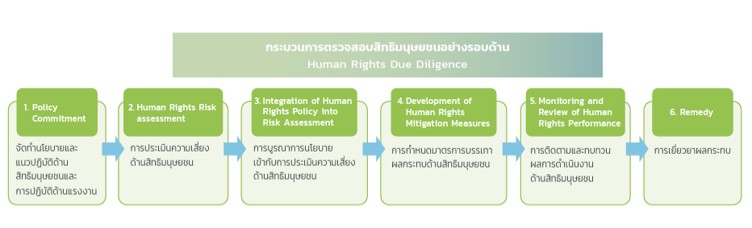
The Company has adopted the Human Rights Due Diligence (HRDD) framework under the UN Guiding Principles on Business and Human Rights (UNGPs) and relevant international labor standards as a systematic framework for managing human rights issues — covering policy formulation, risk identification and assessment, prevention and impact reduction measures, performance monitoring, and remediation of potential impacts — in both the Company's own activities and throughout the value chain. This is integrated into business processes and enterprise risk management to enable effective identification, prevention, and management of significant human rights impacts in alignment with international standards.
Human Rights Due Diligence Process
Human Rights Due Diligence
Pinthong's Human Rights Risk Topics
The Company has identified human rights issues related to its organizational activities and conducted its first human rights risk assessment in 2025, considering risk levels based on the severity of impacts on stakeholders — covering the scope and number of affected persons and the difficulty of remediation — alongside the likelihood of occurrence, to appropriately prioritize issues requiring action. The process covers 100% of the Company's own operations and supply chain activities related to suppliers, contractors, and tenants in the industrial estate. The Company will continuously monitor and evaluate human rights performance, with comprehensive risk and impact reviews scheduled every 3 years or when significant events or changes occur. Progress on risk management plan implementation will be reported to the Corporate Governance and Sustainability Committee for use in defining development approaches and continuously improving operational effectiveness.
| Scope | Human Rights Risk Topics | Affected Stakeholders |
|---|---|---|
| Activities Conducted by the Company |
Labor Rights - Employee Health & Safety (P1) - Employee Employment Conditions (P2) - Workplace Discrimination and Inequality (P3) - Freedom of Association and Collective Bargaining (P4) |
Company Employees |
|
Community Rights - Environmental Impact on Surrounding Community (P5) - Community Health & Safety (P6) |
Community | |
|
Customer Rights - Product and Service Quality (P7) - Customer Health & Safety (P8) - Personal Data and Information Security (P9) |
Customers | |
|
Supplier & Contractor Rights - Supplier and Contractor Health & Safety (P10) |
Suppliers and Contractors | |
| Supply Chain Activities by Suppliers, Contractors, and Estate Customers |
Labor Rights - Health & Safety of Supplier and Contractor Workers (S1) - Employment Conditions of Supplier and Contractor Workers (S2) |
Supplier and Contractor Workers |
|
Community Rights - Community Health & Safety (S3) - Environmental Impact on Community (S4) |
Community |
The Company assesses human rights risks across two dimensions: Likelihood and Severity of impact. Results are classified into 4 levels: Low, Medium, High, and Extremely High risk. From the 2025 assessment, human rights risk topics at high and extremely high levels were identified, which the Company prioritizes for special management. Extremely High — 3 topics: Employee Health & Safety (P1), Customer Health & Safety (P8), and Personal Data & Information Security (P9). High — 5 topics: Employee Employment Conditions (P2), Freedom of Association and Collective Bargaining (P4), Environmental Impact on Surrounding Community (P5), Product and Service Quality (P7), and Community Health & Safety (S3).
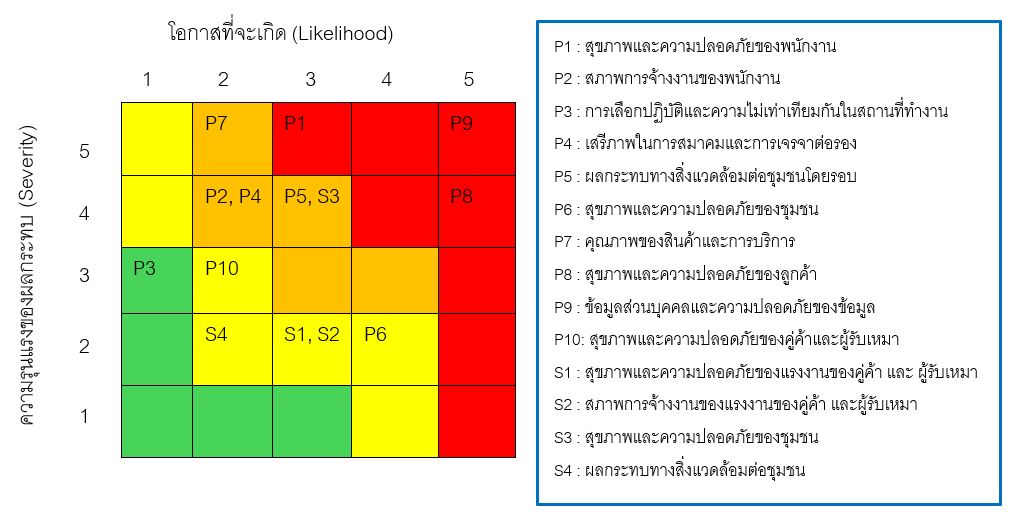
| Risk Level | Color | Risk Level Meaning |
|---|---|---|
| Low Low (L) |
Green | Acceptable risk level requiring no additional risk control or management. |
| Medium Medium (M) |
Yellow | Tolerable risk level requiring control measures to prevent escalation to an unacceptable level. |
| High High (H) |
Orange | Tolerable risk level requiring control and additional measures to prevent escalation to an unacceptable level. |
| Extremely High Extreme High (XH) |
Red | Unacceptable risk level requiring urgent risk management to bring to an acceptable level, plus additional measures to prevent or reduce future impacts. |
The Company uses assessment and risk prioritization results as information for defining appropriate management measures, including listening to the views of directly affected stakeholders, to inform prevention, correction, and remediation measures aligned with actual context and circumstances — covering the organization, the industrial estate, and the entire supply chain — with the aim of reducing both the likelihood and severity of impacts on employees, customers, suppliers, supplier workers, and surrounding communities.
The Company continuously monitors and reviews measure effectiveness through internal audit processes, complaint receipt and review systems, and reviews by relevant departments. When incidents or complaints are received, results are used to evaluate and improve operational approaches and continuously develop additional prevention measures for greater effectiveness.
| No. | High & Extremely High Risk Human Rights Topics | Stakeholders | Current Measures | Additional Future Measures |
|---|---|---|---|---|
| P1 | Employee Health & Safety | Company Employees | 1. Annual employee health checks 2. Annual first-aid training 3. Group insurance for employees 4. Warning signs, fire exit signs, and ready-to-use fire equipment 5. Personal Protective Equipment (PPE) and first-aid equipment 6. System testing plans and annual fire evacuation drills supervised by safety officers (จป.) 7. Regular employee training on fire prevention and equipment use |
1. Review and improve safety measures to suit circumstances 2. Create channels for employees to report safety issues more easily 3. Safety training relevant to employees' job characteristics 4. Regular safety equipment inspection and maintenance |
| P2 | Employee Employment Conditions | Company Employees | 1. Salary structure aligned with the labor market 2. Accurate and transparent employment contracts clearly specifying duties and rights of both parties 3. Employment policies updated in line with labor rights principles, good practices, and changing labor laws 4. Appropriate, fair, and legally compliant employee benefits |
1. Regular communication of labor rights to employees 2. Channels for employee complaints or feedback 3. Labor risk indicator monitoring system (e.g., turnover rate, overtime hours, complaints) 4. Remuneration equity analysis and inequality reduction approaches 5. Regular discussions between management and employee representatives with improvement plans from feedback 6. Control working hours and holidays in compliance with the law |
| P4 | Freedom of Association and Collective Bargaining | Company Employees | 1. Establishment of a workplace welfare committee 2. Annual review of employee benefits 3. Transparent listening to welfare feedback 4. Respect for employee rights to organize and appoint representatives as required by law |
1. Training for employees and management on freedom of association and collective bargaining under international human rights principles 2. Post-welfare improvement follow-up to evaluate whether measures genuinely meet employee needs |
| P5 | Environmental Impact on Surrounding Community | Community | 1. Wastewater treatment and control before public discharge 2. Monthly monitoring of treated effluent quality with results disclosed to communities at EIA Monitoring meetings twice/year 3. Aerator installation at effluent ponds before discharge to reduce color and odor 4. Long-term effluent retention in ponds for 6 months during dry season at Pinthong Projects 5, 6 5. Immediate inspection and correction when wastewater anomalies are found 6. Online BOD meters for continuous post-treatment water quality monitoring |
1. Communicate with communities when treated effluent must be discharged publicly during dry season (Projects 5, 6) 2. Emergency wastewater management plan with immediate community notification procedures when anomalies occur 3. Additional community feedback meetings beyond EIA Monitoring when water quality complaints arise |
| P7 | Product and Service Quality | Customers | 1. Annual equipment and utility system maintenance plans 2. Define service quality standards and response times 3. Monitor customer complaints and resolve within defined timeframes 4. Monitor utility system availability 5. Assess customer satisfaction and apply results to service improvements |
1. Develop tools and technology to improve system anomaly monitoring and surveillance effectiveness 2. Define risk zones with area-specific control measures reviewed periodically 3. Build joint surveillance networks with estate customers (project patrols + security guards + customers) with clear incident reporting procedures 4. Develop Business Continuity Plans (BCP) for utility system failures |
| P8 | Customer Health & Safety | Customers | 1. Maintain safe environment and infrastructure 2. Install safety warning signs and symbols 3. Provide a safety management system for traffic, environment, and infrastructure within the industrial estate 4. Prepare for emergency response 5. Oversee company service quality 6. Channels for customer safety complaints or incident reporting |
1. Regular safety information communication to customers 2. Enhance skills of employees, security officers, and gardeners in maintaining safety for customers and service areas 3. Continuous inspection and maintenance of infrastructure and facilities |
| P9 | Personal Data & Information Security | Employees, Customers, Suppliers | 1. Personal data protection and information security policy 2. Security systems, data storage, access rights, and data recovery 3. Regular system access rights reviews 4. Firewall, antivirus, and threat detection systems 5. Channels for reporting personal data incidents or complaints |
1. Data breach response plan 2. Employee Cyber Security training 3. Data breach and information security incident response plan 4. Continuous review and improvement of information system security measures |
| S3 | Community Health & Safety | Community | 1. Annual pollution monitoring (dust, noise, surface water, groundwater) with community invitation to environmental quality measurements and results disclosed at EIA Monitoring meetings twice/year 2. Online BOD meters for continuous post-treatment water quality monitoring 3. Continuous Air Quality Monitoring System (AQMS) at Pinthong Project 5 4. Supervision and control of construction contractors regarding dust dispersion prevention 5. Community surveys and feedback collection on environmental impacts |
1. Install AQMS at Pinthong Projects 4, 6 2. Guidelines for pollution exceedance with immediate community and agency notification procedures 3. Periodic review of pollution control system effectiveness with improvement plans when continuous upward trends are found |

Grievance Management and Monitoring
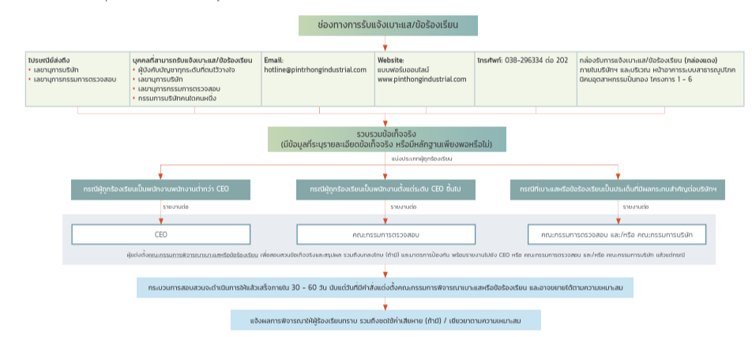
To ensure operations comply with human rights principles and monitor human rights issue management, the Company has established a Whistleblowing Policy and provides multiple communication channels to facilitate reporting by employees and stakeholders of suspected human rights violations, corruption, or illegal and unethical conduct. All cases are carefully, transparently, and impartially investigated under whistleblower protection measures that prioritize informant safety. If investigation confirms wrongdoing, disciplinary action will be taken against offenders and, in cases of legal violations, legal proceedings will follow.
After investigation, the Company will appropriately and fairly correct, mitigate, and remediate impacts — such as financial compensation, rights restoration, or other assistance — with continuous monitoring and evaluation to ensure remediation measures are effective and genuinely address impacts.
Employees and external parties who witness or have information about potentially wrongful conduct may report through the Company's designated channels as follows:
Promoting Diversity, Equity and Inclusion (DEI)
The Company prioritizes promoting Diversity, Equity, and Inclusion (DEI) for all stakeholder groups, adhering to principles of non-discrimination, respect for human dignity, and equal opportunity — integrated into its Human Rights and Labor Practice Policy. The Company promotes fair treatment of employees and stakeholders without discrimination based on gender, age, ethnicity, religion, disability, or any other status; supports a work environment that respects differences and enables everyone to participate and voice opinions; and ensures equal access to complaint mechanisms. DEI-related activities aligned with organizational context include: communication to raise awareness of diversity and non-discrimination, provision of appropriate facilities for vulnerable groups, equal occupational health and safety care, and community engagement considering the diversity of people.
Additionally, the Company promotes employee rights to participation and representation under the principles of freedom of association and collective bargaining, establishing a Workplace Welfare Committee per Section 96 of the Labour Protection Act B.E. 2541 as a mechanism for listening to employee opinions, suggestions, and needs on welfare and working conditions. The Committee consists of elected employee representatives serving 2-year terms, responsible for collecting and presenting issues to management, joint consultations, and communicating outcomes to all employees — strengthening transparency and positive organizational relations.
In 2025, the Workplace Welfare Committee proposed and advocated for welfare and working condition benefits: improvements to leave entitlement criteria under work regulations — including additional sick leave for work-related injuries or illnesses, additional unpaid leave (Leave without Pay) rights, and amendments to provident fund enrollment criteria so employees can join from their first day without waiting through the probationary period. The Company has fully considered and implemented the Welfare Committee's proposals, resulting in employees receiving benefits more appropriate to and aligned with their needs.
Promoting Human Rights Understanding Among Stakeholder Groups
Employees
New employees receive human rights knowledge through orientation programs covering key human rights and labor practice policy content, business ethics, and complaint channels. All current employees receive annual human rights and labor reviews. In 2025, the Company organized a human rights training course by iAmHR Consultants Co., Ltd., with 24 employees participating (26.09% of total staff). Training included lectures and workshops to build understanding of human rights issues and their application in work aligned with the Company's human rights policies and practices.
Suppliers and Contractors
In 2025, the Company assessed human rights risks among 45 Critical Tier-1 Suppliers with direct business relationships, using ESG Self-Assessment Questionnaires (SAQ) for 38 general key suppliers and Site Visits for 7 strategically important key suppliers. Results were used to rank supplier human rights risks and define monitoring, promotion, and capacity-building approaches to ensure suppliers operate in alignment with the Company's human rights standards.
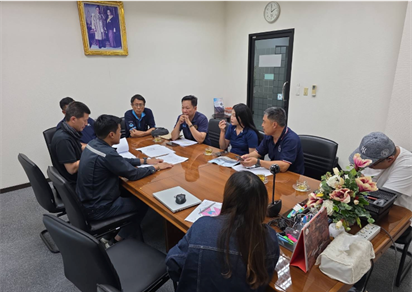
Additionally, the Company communicates its human rights policy to suppliers through Pre-work / Kick-off Meetings to clarify relevant practices, build shared understanding, and provide opportunities for suppliers to ask questions and exchange views before commencing work.
Customers
Transparent, accurate, and comprehensive disclosure of information to customers is one of the Company's key commitments to support efficient customer investment decisions and business operations — particularly key material information such as utility systems, safety measures, emergency management plans, and product and service complaint channels. The Company ensures this information is appropriately accessible and current to build confidence and reduce risks that may affect customer rights. Human rights practices toward customers are integrated through the Customer Relationship Management (CRM) system, with emphasis on personal data protection, data security, and responsible data use, disclosure of key investment decision information, and fair, transparent, and auditable complaint handling processes to ensure customers receive appropriate care and remediation when affected.
Community
The Company operates with emphasis on earning Social License to Operate from surrounding communities, while promoting the economic well-being and safety of local residents, appropriately managing shared resource use — such as not competing with communities for water — controlling and preventing health-threatening pollution, and preventing environmental impacts. Guidelines are communicated to employees who may cause intentional or unintentional, direct or indirect community impacts, to ensure operations appropriately align with sustainable community coexistence. Additionally, the Company conveys community-related human rights practices through relevant internal and local government agencies, and publicizes complaint channels for cases of community human rights violations to enable appropriate investigation and remediation.
Complaint channels are available in cases where community human rights violations are found, to enable appropriate investigation and remediation.
2025 Human Rights Performance
| Human Rights Topic | Indicators | 2025 Target |
2025 Performance |
|---|---|---|---|
| Labor Rights (Employees) | Proportion of employees communicated on human rights | 100% | 100% |
| Number of human rights violation complaints or lawsuits | 0 cases | 0 cases | |
| Employee Health & Safety | Work accident rate | 0 cases | 0 cases |
| Personal Data & Information Security | Number of data breach incidents | 0 cases | 0 cases |
| Number of personal data complaints | 0 cases | 0 cases | |
| Customer Rights | Number of customer safety complaints | 0 cases | 0 cases |
| Supply Chain | Proportion of key suppliers assessed for human rights | 100% | 100% |