Supply Chain Management
Select, assess, and develop suppliers to ESG standards — building a sustainable Green Supply Chain.
Supply Chain ManagementMateriality Level : Medium

Targets & Performance
| KPI | Long-term Target 2030 | Target 2025 | Performance 2025 |
|---|---|---|---|
| Proportion of new suppliers who acknowledged the Supplier Code of Conduct | 100% | 100% | 100% |
| Proportion of the Company's suppliers who acknowledged the Supplier Code of Conduct | 100% | 100% | 100% |
| Proportion of critical suppliers that received a sustainability risk assessment | 100% | 100% | 100% |
Risks & Opportunities
If the Company fails to comprehensively manage suppliers, contractors, and relevant service providers, or lacks appropriate selection, assessment, and monitoring processes, risks may arise from the delivery of work or services that do not meet the agreed terms, quality, or planned timeframes. There are also risks from suppliers failing to comply with relevant laws and standards — such as those concerning the environment, occupational health and safety, labour, and business ethics — which may impact operational efficiency, project continuity, remediation costs, and the confidence of customers, regulators, and relevant stakeholders.
At the same time, appropriate management of suppliers and the supply chain offers opportunities for the Company to raise the operational standards of suppliers, contractors, and relevant service providers through defined selection criteria, clear communication of expectations, performance monitoring, and promotion of appropriate ESG practices. This not only supports the quality and timeliness of the goods and services received by the Company, but also strengthens a business network that is ready to support the development of a modern, smart, and low-carbon industrial city — a key long-term direction of the Company.
Strategy & Management
The Company is committed to conducting business with suppliers and contractors with transparency, honesty, and fairness, while integrating Environmental, Social and Governance (ESG) considerations into operating processes throughout the supply chain — to raise operational standards and appropriately manage supplier risks that may impact the business, society, and the environment.
To ensure operations are aligned in the same direction, the Company has established the Sustainable Supply Chain Management Policy as a framework and standard for working with suppliers, covering transparent and fair supplier selection, assessment of supplier risks on human rights, labour, and workplace safety, promotion of environmentally responsible procurement, and supplier capability development to raise shared operational standards.
In addition, the Company adheres to compliance with relevant laws and standards at both national and international levels — such as Thai labour and environmental laws, the principles of the United Nations Global Compact (UNGC), the UN Guiding Principles on Business and Human Rights (UNGP), the standards of the International Labour Organization (ILO), as well as relevant management standards such as ISO 9001 and ISO 14001, and the Green Industry guidelines of the Ministry of Industry — to govern and promote ethical, responsible, and appropriate business conduct with suppliers.


Governance Structure and Oversight
To ensure that supply chain management operations comply with the defined policy, the Company has established a governance structure and assigned relevant units to be responsible for managing and monitoring supplier and contractor management, as follows:
| Responsible Unit | Roles and Responsibilities |
|---|---|
| Board of Directors | Oversee and approve the Sustainable Supply Chain Management Policy to align with business direction, risk management, and stakeholder expectations. |
| Executive Committee and Chief Executive Officer | Drive the policy into practice, monitor performance, and oversee supplier management in accordance with the Company's plans, including approving or establishing directions for key issues affecting business and operational continuity. |
| Audit Committee | Review the adequacy and effectiveness of internal control, governance, and risk management systems related to the procurement process, to support transparency and prevent corruption. |
| Procurement Department | Serve as the primary unit for selecting, assessing, and monitoring suppliers in accordance with procurement criteria and the Supplier Code of Conduct, including assessing relevant risks per the Company's criteria, and proposing suspension or review of engagements if significant risks or non-compliance are identified. |
| Corporate Governance and Risk Management Department | Support the establishment of frameworks, criteria, and processes for sustainability risk assessment in the supply chain, monitor risk issues and compliance with relevant requirements, and report key matters to management and relevant units for further action. |
| Environmental Quality Monitoring and Inspection Committee | Monitor and provide recommendations on the performance of suppliers and contractors related to the project's environmental issues, to support prevention and mitigation of impacts on surrounding communities and areas. |
| Project Owner Unit | Oversee the operations of contractors and suppliers within the area of responsibility to ensure compliance with safety, environmental, and project requirements, monitor the remediation of deficiencies, and follow defined procedures when operations that may cause risks or impacts are identified. |
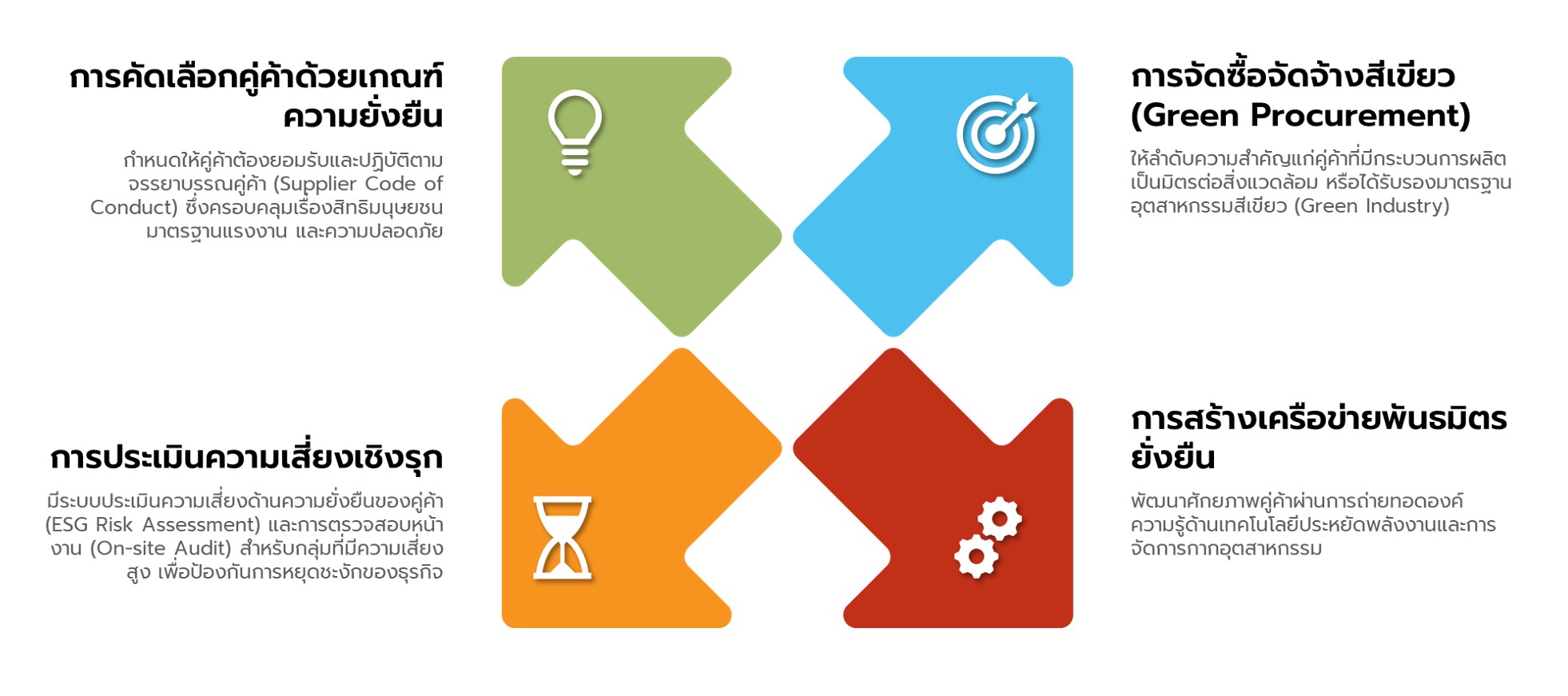
The Company has strategies and action plans to drive a "Green Supply Chain" by focusing on integrating Environmental, Social and Governance (ESG) dimensions into business processes, as follows:
Supplier Code of Conduct & Communication
The Company has established a Supplier Code of Conduct, placing importance on supplier management to promote responsibility toward society, communities, and the environment in line with sustainable development principles, while committed to developing the capabilities of its suppliers for broader social growth. The Company also places importance on communicating the Supplier Code of Conduct to create mutual understanding and establish transparent and responsible business conduct guidelines, providing multiple communication channels so that suppliers can conveniently access information, including:
- Corporate Website — the Sustainable Supply Chain Management Policy and Supplier Code of Conduct are published on the Company's website so that suppliers can access the information at any time.
- Procurement System — the Supplier Code of Conduct is required as part of the new supplier registration process (Supplier Registration) and appended to procurement contracts, requiring suppliers to acknowledge and sign before commencing operations.
- Meetings and Activities with Suppliers — operating guidelines and relevant standards are communicated through various meetings and activities, such as Environmental Impact Assessment monitoring meetings (EIA Monitoring), to build understanding of environmental and safety standards in operations.
This communication covers all of the Company's direct suppliers (Tier 1 Suppliers), especially significant suppliers, who must receive appropriate Environmental, Social and Governance (ESG) risk assessments. New suppliers are also required to sign and acknowledge the Supplier Code of Conduct before formal registration as a supplier. In addition, the Company encourages its direct suppliers to cascade the Supplier Code of Conduct guidelines to their own supply chain partners to raise shared operating standards. The Company targets 100% of suppliers transacting in 2025 to have signed acknowledgement of the Supplier Code of Conduct, with the policy reviewed and updated annually to align with relevant standards and practices.
In 2025, the Company ensured that all 183 suppliers conducting direct business with the Company (Tier-1 Suppliers) (100%) signed acknowledgement of the Supplier Code of Conduct. This included all 72 suppliers (100%) newly registered as suppliers in 2025.
Supplier Categorization
Supplier categorization is an important step in efficiently and appropriately managing the supply chain in the context of the business, as each supplier has different roles, levels of importance, and risk levels to the Company's operations. Supplier categorization therefore enables the Company to define appropriate governance, monitoring, evaluation, and development approaches according to the nature of the business relationship, procurement value, operational significance, and associated risk considerations.
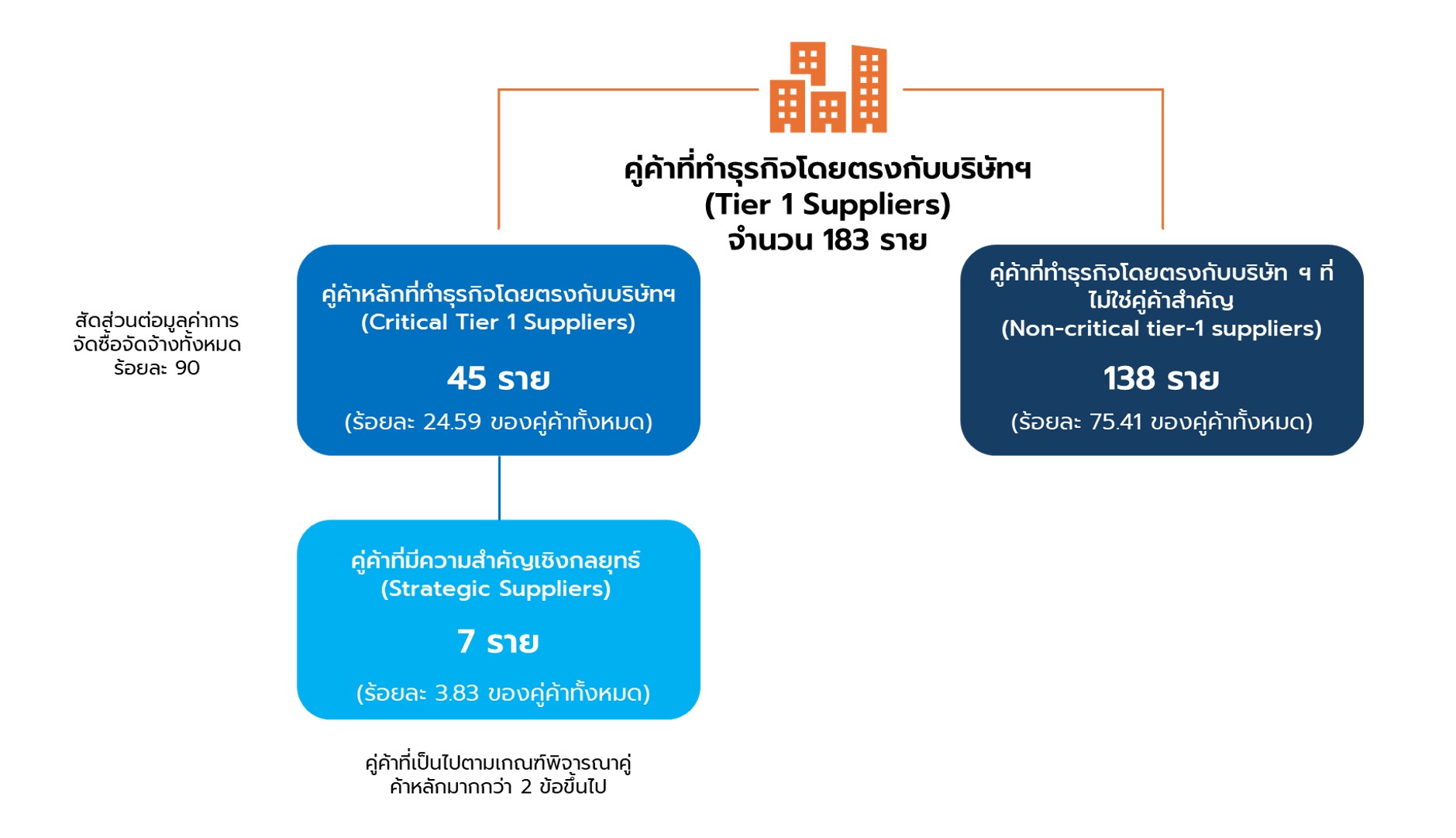
In 2025, the Company had a total of 183 suppliers conducting direct business with the Company (Tier-1 Suppliers), which can be classified into the following groups based on their characteristics and categorization criteria:
1. Direct Critical Suppliers (Critical Tier-1 Suppliers)
Refers to suppliers that directly deliver goods and services to the Company and are of high importance to the Company's operations, where the supplier meets any one of the following criteria:
(1) Has high procurement value, falling within the top 90% of total procurement value, or
(2) Delivers goods and services that are key components of business operations, or
(3) Delivers goods and services that are irreplaceable, or for which there are few alternative suppliers, or on which the Company has high dependence.
2. Strategically Important Suppliers (Strategic Suppliers)
Refers to certain suppliers within the Critical Tier-1 Suppliers group that meet two or more of the critical supplier criteria. In addition to being directly important to operations, they also play a significant role in driving the Company's strategic goals, such as supporting competitive capability, developing key projects or services, offering specialized expertise or technology, and contributing to the Company's long-term growth or competitive advantage.
3. Critical Indirect Suppliers (Critical Non-tier 1 Suppliers)
Refers to supply chain suppliers with whom the Company does not conduct business directly, but who are important to the continuity of goods and service delivery, or who may create significant impacts and risks to the Company's business operations in the event of disruption or failure to meet defined standards.
In 2025, the Company analyzed and categorized its suppliers as follows:
- Total suppliers conducting direct business with the Company (Tier-1 Suppliers): 183 suppliers
- Critical Tier-1 Suppliers: 45 suppliers
- Strategic Suppliers: 7 suppliers
New Supplier Selection & Registration
The Company has a process and criteria for selecting new suppliers, considering General Criteria covering quality, price, and operational efficiency, together with ESG Criteria covering environmental, social, and governance dimensions, as part of the conditions for new supplier selection. New suppliers are required to complete a Self-Assessment Questionnaire (SAQ) and must achieve a minimum score of at least 60% to be registered on the Approved Vendor List (AVL).
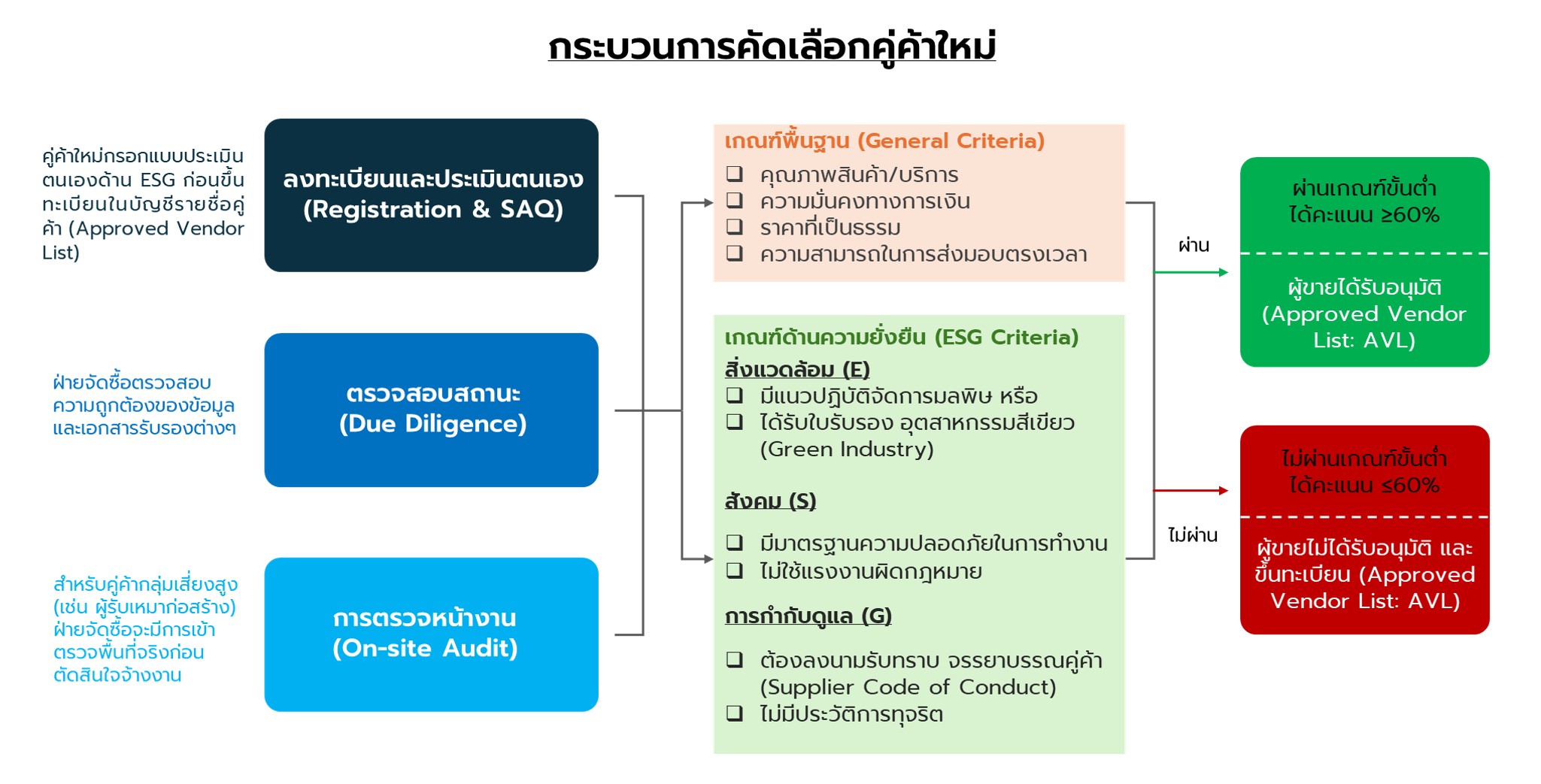
In 2025, a total of 72 suppliers met the criteria and were registered as new suppliers of the Company, representing 39.34% of all the Company's suppliers.
Supplier Risk Assessment
The Company conducts risk assessments of its suppliers to ensure that business conduct with suppliers aligns with business ethics principles and addresses Environmental, Social, and Governance (ESG) considerations. The risk assessment process is as follows:
1. Use of Self-Assessment Questionnaire (SAQ)
The Company requires suppliers to complete a self-assessment using a questionnaire prepared by the Company. New suppliers must complete the assessment and achieve a score of more than 60% before being registered as a supplier, while existing suppliers complete an annual assessment with a passing score of more than 70%. The content of the questionnaire aligns with the Supplier Code of Conduct and covers key issues, including:
Governance
Conducting business with transparency and ethics, anti-corruption, respect for intellectual property, and transparency in management.
Social
Strict compliance with labour laws and human rights principles, such as fair wage payment, equal treatment, prohibition of child labour, forced labour, or illegal labour, and having appropriate occupational health, safety, and working environment measures, as well as the provision of Personal Protective Equipment (PPE).
Environment
Having an environmental policy or management system and strictly complying with laws, such as ISO 14001 certification or Green Industry standards, as well as the capability to manage waste, air pollution, and wastewater from operations, especially for construction contractors and activities that may affect the industrial estate area.
2. Risk Profiling & Tiering
The Procurement Department analyzes data from the self-assessment questionnaire together with other relevant factors to classify suppliers into low, medium, and high risk groups, with the following assessment criteria:
- Business Type — construction contractors and hazardous material transporters are classified at a higher risk level than office equipment suppliers.
- Procurement Value — suppliers with high transaction values and impact on Business Continuity.
Criteria for Risk Analysis
| Score | Assessment Result | Risk Level | Measures |
|---|---|---|---|
| More than 70% | Good | Low |
|
| Between 30–70% | Fairly Good | Medium |
|
| Less than 30% | Needs Improvement | High |
|
Supplier Compliance Assessment & Audit
In 2025, the Company has a system for auditing and monitoring supplier operations, especially High Risk suppliers and Critical Suppliers, to ensure that supplier operations comply with environmental and social standards, business ethics principles, and the Eco-Industrial Town development guidelines. The Company therefore defines a supplier assessment and governance process throughout the project period, covering performance assessment, on-site inspection, follow-up monitoring, and disclosure to stakeholders, as follows:
1. Core Assessment Areas
The Company defines supplier performance assessment criteria consistent with labour standards and business ethics, covering key areas including:
- Working Hours and Wages — verify that suppliers pay wages and benefits to workers at no less than the legally required amount, and manage working hours and overtime in compliance with labour law.
- Occupational Health and Safety — inspect working environments, especially at construction sites or contractor work areas, to ensure appropriate Personal Protective Equipment (PPE) is provided, a safety management system is in place, and the workplace accident rate is kept low.
- Fair Labour Treatment — verify supplier operations comply with human rights principles, such as prohibiting child labour, forced labour, or illegal labour, and ensuring no discrimination in the workplace.
- Environmental Impacts — verify supplier operations comply with relevant environmental measures, such as measures under the Environmental Impact Assessment (EIA) report, including pollution management and relevant treatment systems.
2. Inspection and Reporting Methods
Supplier performance is inspected and monitored through On-site Audit processes, where the Procurement Department team together with project supervisory units conduct periodic on-site inspections to observe actual operations, and in some cases worker interviews may be conducted as part of the assessment. Inspection results are summarized as scores according to the Company's ESG criteria and reported to the Executive Committee to acknowledge the supply chain risk status and inform appropriate management guidelines.
3. Follow-up and Corrective Action Measures
In cases where supplier operations are found to be non-compliant with the Company's defined standards, the Company will implement systematic management measures as follows:
- Corrective Action Plan — the Company will notify suppliers of deficiencies in writing and require suppliers to prepare an improvement plan within a defined period, such as 15–30 days, depending on the severity of the issue.
- Follow-up — the team will conduct re-inspections to confirm that corrections have been effectively implemented and can prevent recurrence.
- Promotion and Governance Measures — suppliers with good performance will be classified as Grade A suppliers and may be considered for future project participation. In cases where serious standard violations are found, such as in worker health and safety, and no corrective action is taken, the Company will apply suspension of engagement or consider removal from the vendor list (Blacklist) as appropriate.
4. Public Disclosure of Performance Results
The Company compiles and summarizes supplier assessment results, the number of suppliers developed, and corrective action measures implemented during the year for disclosure in the Company's annual sustainability report — to reflect transparency in supply chain governance and demonstrate that the Company's suppliers must not only deliver quality goods and services, but also conduct business ethically and prioritize fair labour care in accordance with the Company's defined standards.
In addition, in 2025 the Company also focused on developing digital systems to support supplier monitoring and assessment, to enhance efficiency, data accuracy, and transparency in the governance process. Stakeholders can study further details regarding assessment criteria in the Company's Corporate Governance Policy.
Risk assessment results and on-site audit outcomes according to the defined criteria
In 2025, the Company conducted sustainability risk assessments for a total of 117 suppliers, representing 100% of the suppliers within the assessment scope, covering 7 Strategic Suppliers, 38 Critical Tier-1 Suppliers, and 72 new suppliers. In addition, the Company conducted On-site Audits for 7 Strategic Suppliers, representing 100% of that supplier group.
The assessment results found no suppliers with high to very high environmental, social, and governance risks across all supplier groups assessed. Accordingly, the Company has no suppliers requiring special corrective measures due to significant environmental or social impact issues, and there are no cases of business relationship termination as a result of the assessment in this reporting period.
| Number (Suppliers) | Proportion | |
|---|---|---|
| Total suppliers receiving a sustainability risk assessment | 117 | 100 |
| • Strategic Suppliers | 7 | 100 |
| • Critical Tier-1 Suppliers | 38 | 100 |
| • New Suppliers | 72 | 100 |
| Suppliers audited on-site (On-site Audit) | 7 | 100 |
| • Strategic Suppliers | 7 | 100 |
| Suppliers with high–very high ESG risk | 0 | 0 |
| • Strategic Suppliers | 0 | 0 |
| • Critical Tier-1 Suppliers | 0 | 0 |
| • New Suppliers | 0 | 0 |
Responsible Procurement
In its business operations in 2025, Pinthong Industrial Park Public Company Limited elevated its Responsible Procurement standards, particularly in infrastructure development and utility system work, to align with the Eco-Industrial Town development guidelines. The Company therefore established a systematic supply chain governance process, covering material source verification, supplier selection, and supplier performance monitoring, as follows:
1. Traceability and Source Verification
The Company places importance on verifying the source of construction materials and utility system equipment to ensure that the materials used are of quality and consistent with environmental standards, with the following operational approaches:
- Green Material Criteria — select construction materials with environmental certification, such as Green Label, materials with recycled content, or products with Green Industry certification.
- Source Verification — require suppliers to provide Thai Industrial Standard (TIS) certification documents and related documents on the origin of key materials, such as steel, cement, and electrical equipment, to confirm that products comply with the law and do not originate from production sources that violate environmental or human rights laws.
2. Systematic Supplier Selection Process
The Company defines a supplier selection process to ensure that suppliers have the capability and comply with the Company's standards, comprising:
- Pre-qualification — new suppliers in engineering and utility system work must pass Due Diligence, covering both financial stability and compliance with the Supplier Code of Conduct.
- ESG Factor Consideration in Selection — the Company incorporates environmental management and safety factors in contractor selection, in addition to price and quality criteria.
3. Monitoring & Compliance
During project execution, the Company continuously monitors supplier performance to ensure compliance with the Company's requirements and relevant laws, including:
- On-site Inspection — the Company's supervision team regularly inspects material use and contractor operations to ensure compliance with environmental measures under the Environmental Impact Assessment (EIA) report.
- Human Rights Inspection — random checks of employment evidence and worker conditions are conducted to ensure that no illegal labour is used in the Company's supply chain.
- Whistleblowing System — channels are provided for employees and external parties to report information if corruption or non-standard operations are detected.
4. Non-compliance Case Management
If non-compliance is detected, such as use of materials without proper provenance or in violation of ethics, the Company will implement measures according to the severity of the case — from ordering work stoppages for correction, defining improvement measures, to reducing the supplier's trust rating or acting in accordance with the conditions specified in the contract.
In 2025, 27 of the Company's 45 critical suppliers (60%) supplied environmentally friendly goods and services, supporting the procurement of environmentally certified materials and products for use in industrial estate infrastructure and utility system development.
Local Procurement Promotion
The Company places importance on supporting the local economy alongside systematic and efficient supply chain development. Sourcing goods and services from local entrepreneurs not only helps distribute income to communities and strengthen regional economic resilience, but also reduces transportation distances — contributing to reduced energy use and greenhouse gas emissions — and enhances logistics management flexibility for the Company.
For the Pinthong Industrial Park's operations, local procurement covers both infrastructure development work and services within the estate, such as purchasing construction materials including stone, soil, sand, and concrete for road development and maintenance, utility systems, and common areas of the estate, as well as sourcing goods and services related to utility system management such as water supply systems, wastewater treatment systems, and waste management, along with security services, maintenance, and other support services from local operators.
In addition, the Company also places importance on supporting local entrepreneurs in general services, such as cleaning, landscaping, internal transportation, and consumable supply procurement for office operations and various activities within the estate. This approach concretely reinforces local economic growth, enhances management efficiency, and builds good relationships with communities and stakeholders surrounding the Company's industrial estate.
| 2566 | 2567 | 2568 | |
|---|---|---|---|
| Proportion of goods and services procured within Thailand (%) | 100 | 100 | 100 |
| Proportion of goods and services procured within the Eastern Region (%) | 26.8 | 26.5 | 26.7 |
| Proportion of goods and services procured within Chonburi and Rayong Provinces (%) | 26.8 | 26.5 | 26.7 |
Supplier Capability Development
The Company places importance on elevating supplier capabilities, focusing on developing suppliers to operate in alignment with Environmental, Social, and Governance (ESG) standards, coupled with strengthening knowledge, practices, and systematic monitoring and evaluation, to enable continuous development and responsible business operations.
In 2025, the Company implemented 2 key projects, namely the Green Supply Chain Network development and the Contractor Safety and Occupational Health Standards Development Project, with details as follows:
“Green Supply Chain Network” Project
The Company aims to develop suppliers as part of the “Green Supply Chain Network”, serving as a central hub for setting sustainability development standards, transferring knowledge, and creating incentives for suppliers to adapt and elevate operations in a unified direction throughout the supply chain — from selection, evaluation, development, and follow-up, in accordance with the Supplier Code of Conduct — while promoting environmental impact reduction, such as supporting ISO 14001 certification or development of environmentally friendly products, alongside elevating labour, safety, and governance standards.
In addition, the Company uses supplier ESG assessment results to inform supplier selection and ranking, such as granting access to projects, contract renewals, or considering additional business opportunities, to incentivize suppliers to improve their operations. The Company also uses digital systems to compile and track supplier assessment data to enable analysis and follow-up on development. These operations therefore help elevate supplier standards, reduce environmental impacts, and strengthen collaboration in responsible business conduct.
Contractor Safety and Occupational Health Standards Development Project
The Company developed safety and occupational health standards for contractor suppliers in construction and maintenance work, to raise working standards for safety and reduce workplace accidents, targeting a Zero Accident goal. All contractors are required to complete a Safety Induction training before commencing work on site. In 2025, 248 contractor workers received training, representing 100% of all workers, and joint inspections of machinery, equipment, and Personal Protective Equipment (PPE) readiness were regularly conducted between the Company's engineering team and suppliers.
As a result of the project, suppliers have developed a more systematic safety management system, with accident prevention measures established, workplace safety plans prepared, Personal Protective Equipment (PPE) provided, and employee work supervised in compliance with occupational health and safety requirements, achieving a reduction in the workplace accident rate to 0 incidents — or a rate of 0 per total working hours. This helps reduce risks from construction project disruptions and strengthens confidence among operators investing in the industrial estate.
Supplier Liquidity Management
The Company places importance on managing supplier liquidity as part of ethical and fair business conduct, to support supplier financial stability and strengthen supply chain sustainability. The Company therefore defines a clear payment policy appropriate to the nature of goods and services, with a Standard Credit Term of approximately 30–60 days as stipulated in contracts. The Company particularly supports Small and Medium Enterprise (SME) supplier partners by maintaining payment timelines as agreed, to help reduce their liquidity burden and support their business operations.
In 2025, the Company was able to make payments to suppliers within an average of approximately 24 days, which is in line with or faster than the timeline defined in the policy. The Company developed the invoice submission and payment process to be clear and systematic to reduce delays that may arise from documentation procedures, while supporting the use of an online invoicing system so that suppliers can conveniently and quickly track payment status, and transparently communicating payment schedules in advance to help suppliers effectively plan their cash flow management.
| Item | 2566 | 2567 | 2568 |
|---|---|---|---|
| Average payment period to suppliers (days) | 22 days | 21 days | 24 days |