Materiality Topics
Assessed and prioritized through Double Materiality principles to guide operational direction and build long-term value
Materiality Topics
The Company places importance on identifying and assessing material sustainability topics to inform strategy formulation, operational direction, risk management, and long-term value creation for the organization and stakeholders. In 2025, the Company reviewed the 2024 material topics, improving the assessment and prioritization process to align with current business context and international best practices.
The Company has applied the Double Materiality principle in assessing material sustainability topics, considering both impacts on the economy, environment, and society from the Company's business operations throughout the value chain (Impact Materiality), and financial impacts that may affect the Company (Financial Materiality), referencing GRI 3: Material Topics 2021 and the European Sustainability Reporting Standards (ESRS) to make the assessment more systematic and credible.
Materiality Review and Assessment Process
1. Analysis of Industry and Business Context
The Company studied and analyzed both external and internal contexts to identify sustainability risks and opportunities relevant to industrial estate development and management — considering external factors such as global economic changes, industrial investment trends, environmental and social regulations, the low-carbon economy transition, and stakeholder expectations at local, regional, and international levels that may affect business operations and the value chain; alongside assessment of internal factors such as strategic direction and organizational goals, infrastructure and utility development models, relationships with customers, operators, and surrounding communities, as well as internal factors that may create risks and opportunities for the Company's operations.
2. Review of Sustainability Topics and Sub-topics
The Company reviewed 2024 material sustainability topics by considering sustainability topics relevant to industrial estate operations from various international standards and from peer leading companies in the same industry — alongside applying external and internal context analysis results, covering industry trends, relevant regulations, stakeholder expectations, and potential risks and opportunities. The Company then used this information to group and refine the list of sustainability topics for clarity, reduced duplication, and alignment with business context and value chain.
3. Assessment of Impact Significance from Business Operations along the Supply Chain
The Company assigned executives and experts from relevant internal and external units to jointly assess the level of economic, environmental, social, and human rights impacts from business operations in each sustainability topic — comprehensively considering positive and negative impacts that occurred or may occur along the value chain at various times. The assessment applies criteria including severity of impact, scope and affected groups, likelihood of occurrence, and ability to remediate — combined with in-depth information from stakeholder engagement.
4. Assessment of Financial Significance of Sustainability Topics
Senior executives jointly considered risks and opportunities associated with each sustainability topic that may affect performance, financial position, cash flow, and growth potential in the short, medium, and long term — assessing the financial significance level for each topic, considering the severity of financial impact and the likelihood of occurrence of each risk or opportunity.
5. Prioritization of Sustainability Topics
The Company prioritizes assessed significance results and presents them in a Materiality Matrix to clearly show the position of each sustainability topic — with the horizontal axis (X) representing Impact Materiality (economic, environmental, and social impacts from the Company's operations) and the vertical axis (Y) representing Financial Materiality (financial impacts on the Company). The Company has set the threshold for identifying high-significance topics at 2.40 and above; topics meeting the threshold in either dimension are classified as high-priority material topics.
6. Approval of Material Sustainability Topics
The Company's material sustainability topics have been reviewed for accuracy and appropriateness of the assessment and prioritization process by the Sustainability Working Group, before being submitted for approval by senior executives and the Board of Directors in turn — to ensure the identified topics align with the Company's business direction and corporate governance.
Material Sustainability Topics
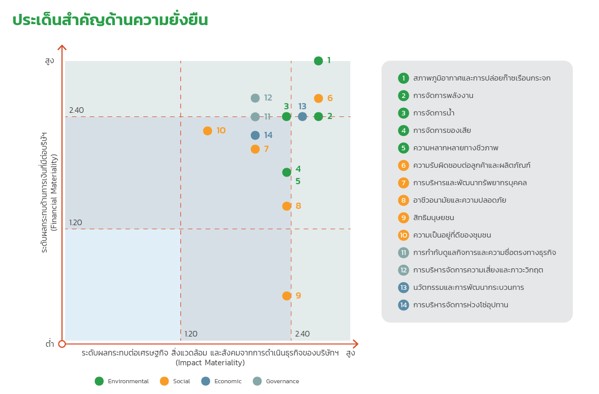
Following the 2025 review and assessment, the Company identified 14 material sustainability topics, down from 20 topics in 2024 — comprising 7 high-priority topics and 7 medium-priority topics. Details of impacts, risks, and opportunities of the high-priority material topics are as follows:
1. Climate and GHG Emissions
| Sub-topic | Impact, Risk, Opportunity | Actual or Potential Impact | Supply Chain | Timeframe |
|---|---|---|---|---|
| GHG Emissions | Actual Negative Impact | Direct and indirect GHG emissions from PIN and estate factory activities increase atmospheric GHG concentrations, contributing to physical climate change affecting ecosystems and society. | Own Operations - Downstream | Short-term |
| Business Opportunities from Climate Policy and Regulatory Changes | Financial Opportunity | Government promotion and support (BCG program, green tax measures) open opportunities to develop into Green / Low-Carbon Industrial Estate or create new carbon and environmental services, elevate standards and certifications (high-tier Eco-Industrial Town, Net Zero Park) to enhance brand value and investor confidence. | Own Operations - Downstream | Long-term |
| Opportunities from Low-Carbon Infrastructure Development | Financial Opportunity | Develop clean energy electricity such as solar cells and smart energy management systems, including carbon offset projects, to help reduce the industrial estate's overall GHG emissions. | Own operations | Medium-term |
2. Energy Management
| Sub-topic | Impact, Risk, Opportunity | Actual or Potential Impact | Supply Chain | Timeframe |
|---|---|---|---|---|
| Energy Consumption | Potential Negative Impact | Inefficient energy systems or fossil fuel use results in high GHG emissions, accelerating climate change and leading to weather volatility, biodiversity loss, and social impacts. | Own operations - Downstream | Short-term |
| Energy Use Efficiency | Potential Positive Impact | Efficient energy management infrastructure enhances power distribution quality with stability and reduces transmission losses, enabling efficient and sustainable industrial area development and expansion. | Own operations | Medium-term |
| Opportunities from Clean Energy Systems and Smart Infrastructure | Financial Opportunity | Investment in renewable energy systems such as Solar Rooftop or clean energy power plants, and smart energy infrastructure development (Smart Grid, automated energy monitoring) to elevate estate energy management efficiency and reduce carbon emissions. | Own operations | Medium-term |
3. Water Management
| Sub-topic | Impact, Risk, Opportunity | Actual or Potential Impact | Supply Chain | Timeframe |
|---|---|---|---|---|
| Water Scarcity Risk | Financial Risk | Drought conditions and changes in rainfall patterns may cause the estate to be unable to supply sufficient water for operators, leading to production disruptions or temporary capacity reductions. | Upstream – Own operations | Long-term |
4. Customer and Product Responsibility
| Sub-topic | Impact, Risk, Opportunity | Actual or Potential Impact | Supply Chain | Timeframe |
|---|---|---|---|---|
| Product and Service Safety | Potential Negative Impact | Designing or providing infrastructure without considering safety and specific needs of different operator types may expose estate workers and surrounding communities to risks of accidents, health, and quality of life. | Own operations | Short-term |
| Risk of Service Non-compliance with Safety and Sustainability Standards | Financial Risk | Accidents or utility failures within the estate cause the Company to bear repair costs, damage compensation, or legal liability claims, and impact service revenue and tenant retention capability. | Own operations | Medium-term |
| Opportunities from Elevating Sustainable Customer and Service Management | Financial Opportunity | Developing customer management systems and proactive service design that precisely meets customer needs may increase lease renewal rates, use of additional estate services, and attraction of new operators — resulting in continuous operational revenue and additional revenue sources in the long term. | Own operations | Long-term |
5. Corporate Governance and Business Integrity
| Sub-topic | Impact, Risk, Opportunity | Actual or Potential Impact | Supply Chain | Timeframe |
|---|---|---|---|---|
| Risk of Ineffective Governance | Financial Risk | Unclear management structure and lack of checks and balances, lack of transparency — such as unclear procurement criteria or misuse of internal information; management or Board making delayed decisions, failing to monitor key issues, or inadequately overseeing environmental and safety risks — resulting in operational errors, unforeseen events, or delayed response, leading to damage to estate operators and surrounding communities. | Own operations | Short-term |
6. Risk and Crisis Management
| Sub-topic | Impact, Risk, Opportunity | Actual or Potential Impact | Supply Chain | Timeframe |
|---|---|---|---|---|
| Risk of Operational Disruption from Emergencies | Financial Risk | Natural disasters (floods, storms) or emergencies (fires, floods, chemical leaks) or utility system failures within the estate cause temporary disruption of utilities (electricity, water, or wastewater treatment) and impact operator activities within the estate. | Own operations | Medium-term |
7. Innovation and Process Development
| Sub-topic | Impact, Risk, Opportunity | Actual or Potential Impact | Supply Chain | Timeframe |
|---|---|---|---|---|
| Opportunities from Digital Technology for Utility and Environmental Management | Financial Opportunity | Digital technology and smart systems such as real-time data analytics, real-time water quality monitoring, Smart Grid, or Energy Management Systems (EMS) enhance utility and environmental management efficiency, reduce losses, and increase reliability in serving estate operators. | Own operations | Medium-term |
| Innovation for Sustainability | Actual Positive Impact | Innovations supporting renewable energy, industrial symbiosis for shared resource use, and carbon capture technologies help reduce climate change and drive the overall industrial system toward sustainability. | Own operations - Downstream | Long-term |
Managing Material Sustainability Topics
High-priority material sustainability topics are incorporated into strategy formulation, risk management, and action planning — with appropriate targets and KPIs defined, progress tracked, and performance disclosed continuously.
Medium-priority topics continue to be monitored under the organization's normal risk management and operational processes, with periodic reviews to consider changes in business context, stakeholder expectations, and potential future risks and opportunities. The Company has assigned relevant units to implement defined approaches, linking sustainability performance indicators to executive and employee performance evaluations appropriately and systematically.